
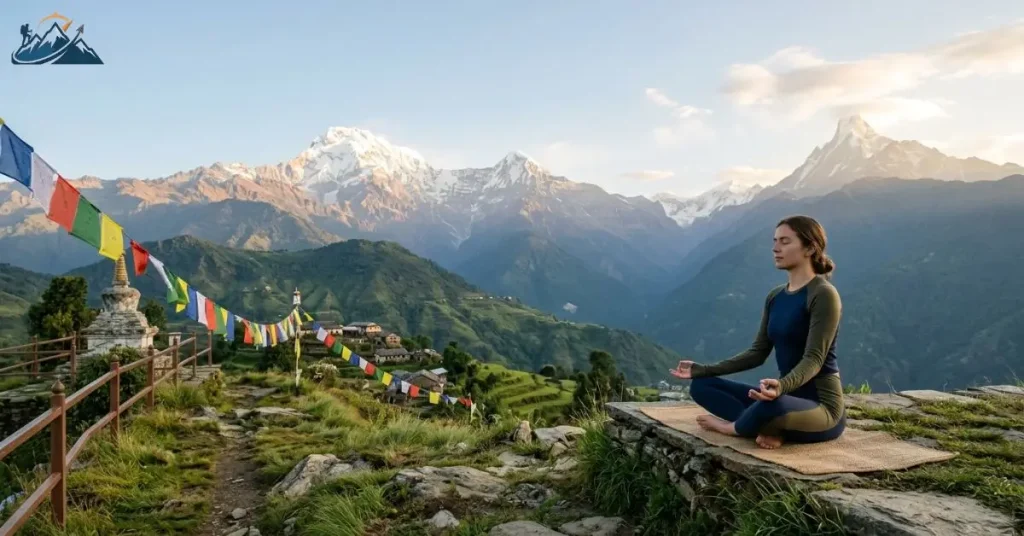
Nepal Wellness Year 2027 is a year-long national campaign, officially announced by the Nepal Tourism Board (NTB) in coordination with the Ministry of Culture, Tourism, and Civil Aviation (MoCTCA), dedicated to promoting wellness tourism in Nepal. The strategy and campaign framework were unveiled at an official launch event organized by the tourism ministry and NTB in Kathmandu.
At the unveiling, Minister for Culture, Tourism, and Civil Aviation Badri Prasad Pandey framed the initiative simply: don’t just visit Nepal, come to discover yourself. NTB Chief Executive Officer Deepak Raj Joshi and other industry officials positioned the campaign as a way to shift part of Nepal’s tourism narrative from pure adventure toward holistic, self-discovery-oriented travel.
Nepal Wellness Year 2027: Key Takeaways
- Nepal Wellness Year 2027 is a government initiative, not a private marketing campaign.
- Backed by a 10-year strategy (2026-2035) and a five-year action plan (2026-2030).
- Targets 11% of Nepal’s international arrivals for wellness tourism by 2030.
- Four core sectors: spa and massage, Ayurveda, yoga and meditation, and natural healing.
- Priority regions: Pokhara, Kathmandu Valley, Lumbini, Mustang, Manang, Nagarkot, and Dhulikhel.
- Certification standards for wellness providers are not fully in place until the end of 2027.
- Wellness tourism adds to Nepal’s adventure tourism identity. It does not replace it.
- Expected foreign wellness tourists: 500 to 1,000 in 2026-27, rising to 10,000+ after 2030.
What Is Nepal Wellness Year 2027, and What Does It Mean?
Nepal Wellness Year 2027 is a year-long national campaign, officially announced by the Nepal Tourism Board (NTB) in coordination with the Ministry of Culture, Tourism, and Civil Aviation, dedicated to promoting wellness tourism in Nepal. The announcement was made on April 15, 2026, during Nepal’s first celebration of International Wellness Day, held at Sainik Manch, Tundikhel, in Kathmandu.
At the event, Minister for Culture, Tourism, and Civil Aviation Badri Prasad Pandey framed the initiative simply: don’t just visit Nepal, come to discover yourself. NTB Chief Executive Officer Deepak Raj Joshi and other officials positioned the campaign as a way to shift part of Nepal’s tourism narrative from pure adventure toward holistic, self-discovery-oriented travel.
Why Did Nepal Declare 2027 the Year of Wellness?
Nepal declared 2027 the Year of Wellness mainly because of a diplomatic milestone it achieved the year before. On March 10, 2026, the United Nations General Assembly adopted a landmark resolution, initiated by Nepal and co-sponsored by 40 other member countries, establishing April 15 as International Wellness Day. It marked the first time Nepal acted as the sole penholder of a UNGA resolution creating an international observance day.
That diplomatic win gave Nepal a natural platform to launch a bigger tourism repositioning. Rather than let the recognition pass as a one-day event, the government tied it to a full calendar year (2027) and a 10-year tourism strategy (National Wellness Tourism Strategy 2026–2035), aiming to convert cultural and diplomatic momentum into an actual tourism sector.
There is also an economic logic. Wellness travelers are considered a high-value traveler segment. Global data from the Global Wellness Institute (GWI) cited by Nepali officials suggests wellness tourists typically spend around 53% more per trip than average international tourists. For a country working to diversify tourism revenue beyond peak-season trekking, that spending pattern is a strong incentive.
What Is International Wellness Day, and Why Is It on April 15?
International Wellness Day is a UN-recognized observance day held annually on April 15, created at Nepal’s initiative and adopted by the UN General Assembly on March 10, 2026, with support from 143 member countries. The first observance took place on April 15, 2026, in Kathmandu, coinciding with the announcement of Nepal Wellness Year 2027.
The date itself does not correspond to a specific historic wellness event in Nepal. It was proposed by Nepal as the annual date for the observance going forward, and the country used its first celebration as the launchpad for the broader wellness tourism strategy.
Nepal’s National Wellness Tourism Strategy 2026-2035 Explained
The centerpiece behind Nepal Wellness Year 2027 is the National Wellness Tourism Strategy (2026-2035), paired with a five-year action plan (2026-2030). This is the document that answers “What is Nepal’s wellness tourism strategy?” in concrete terms rather than slogans.
The Four Core Sectors of Nepal’s Wellness Tourism Strategy
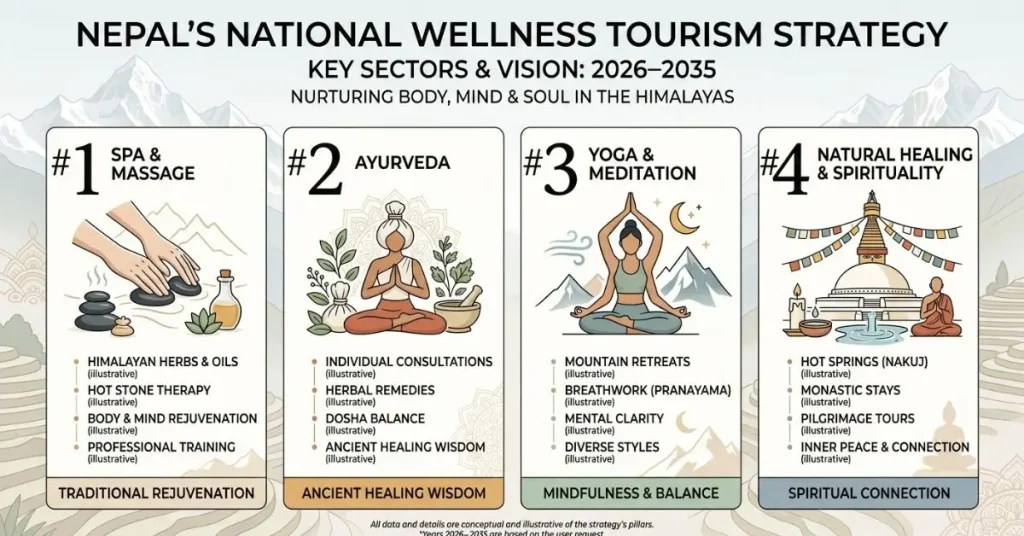
The strategy is built around four pillars of wellness tourism:
| Sector | What it Covers |
|---|---|
| Spa and massage services | Wellness spas, therapeutic massage, recreational relaxation services |
| Ayurveda clinics | Traditional Ayurvedic treatment, diagnosis, and herbal therapy |
| Yoga and meditation | Yoga retreats, meditation centers, mindfulness programs |
| Natural healing and spirituality | Nature-based healing, pilgrimage travel, spiritual retreats tied to Nepal’s religious heritage |
Nepal’s Wellness Tourism Targets for 2026-2030 and Beyond
Nepal’s approach to Nepal wellness tourism 2027 is deliberately staged rather than immediate:
- 2026-27 (pilot phase): Test infrastructure and services by attracting 500-1,000 foreign wellness tourists.
- 2028-29 (expansion phase): Scale facilities to attract 3,000-5,000 foreign wellness tourists.
- Post-2030 (maturity phase): Target more than 10,000 foreign wellness tourists annually, generating an estimated US$20-30 million in yearly revenue.
By 2030, the government’s stated goal is for wellness travelers to make up 11% of Nepal’s total international arrivals, up from an estimated 2% currently.
Other Key Goals of Nepal’s Wellness Tourism Strategy
- A “Wellness Nepal” / “Arogya Nepal” marketing campaign to build international brand recognition.
- A National Wellness Standards and Code of Conduct, to be implemented by the end of 2027, so travelers can trust the quality of certified wellness providers.
- Plans to establish at least five integrated wellness hubs across the country.
- A commitment that roughly 30% of jobs created in the sector go to women, youth, and local communities.
- Seven target traveler groups, including international yoga practitioners, spiritual seekers, health and wellness tourists, adventure-and-wellness hybrid travelers, spa tourists, corporate wellness groups, and family wellness travelers.
| Important: This strategy is still in its early implementation phase as of 2026. Some elements, like the certification code of conduct, are planned but not yet fully in force. Travelers should treat 2027 as the year infrastructure and offerings ramp up, not a year where every wellness service is already standardized. |
Top Wellness Tourism Destinations in Nepal
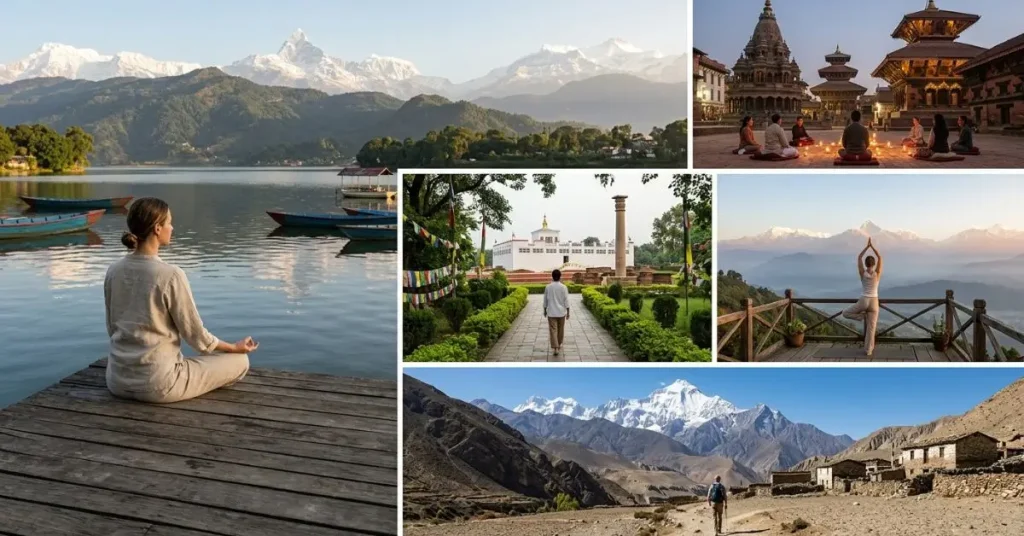
Nepal’s geography gives it a genuine advantage for wellness travel. It does not need to build a wellness identity from nothing; it already has the settings for it. The strategy identifies specific regions for different types of wellness experiences:
- Kathmandu Valley: Spiritual and cultural wellness, spa services, and access to Nepal’s religious heritage sites.
- Pokhara: Lakeside retreats, yoga centers, and nature-based relaxation with Annapurna views.
- Lumbini: Positioned as a spiritual wellness hub, tied to its significance as the birthplace of the Buddha.
- Nagarkot and Dhulikhel: Being developed as eco-retreat destinations near the Kathmandu Valley rim.
- Mustang and Manang: High-altitude wellness programs built around herbal resources and mountain climates, blending wellness with Nepal’s trekking terrain.
Two properties are frequently cited as examples of what world-class wellness hospitality already looks like in Nepal: Dwarika’s Sanctuary, a wellness-focused retreat outside Kathmandu, and Shinta Mani Mustang, a high-end lodge in Upper Mustang. Their existence shows that premium wellness infrastructure is not purely theoretical. It is already operating, and the national strategy aims to build more capacity around this model.
| Local Insight: Many of these wellness regions overlap directly with places Nepal is already known for. If you’ve researched a Kathmandu Valley travel guide or looked into Pokhara, you’re already looking at emerging wellness destinations. You don’t need an entirely separate itinerary. |
Yoga and Meditation Retreats in Nepal: What Travelers Should Know
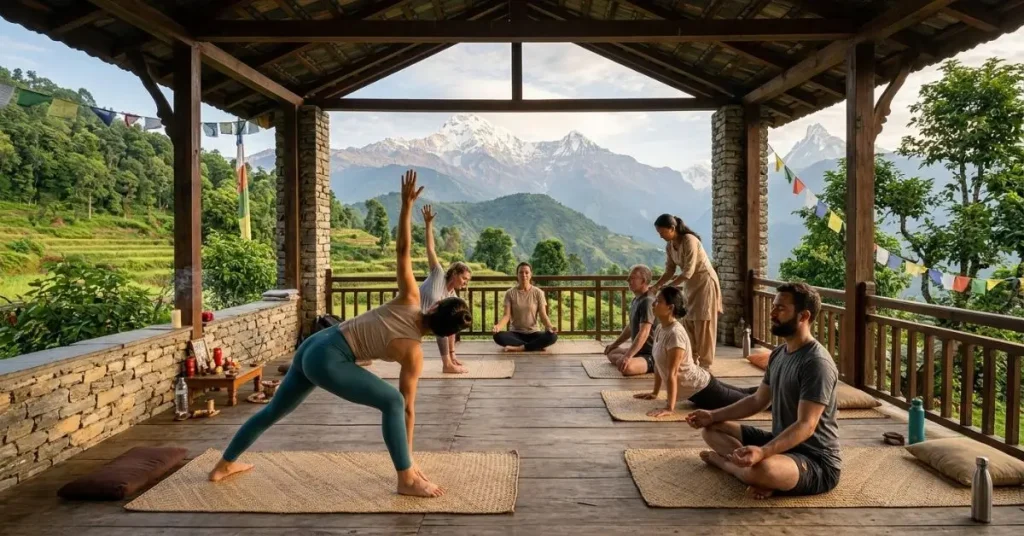
Yoga and meditation retreats in Nepal are not new. Nepal has hosted informal and small-scale retreats for years, particularly around Pokhara, Kathmandu, and Lumbini. What is changing under Nepal Wellness Year 2027 is standardization and visibility rather than the core offering itself.
As of 2026, Nepal does not yet have a single centralized government booking platform or certification list for yoga and meditation retreats. That is part of what the Code of Conduct, expected by the end of 2027, aims to formalize. Until then, retreat quality still varies significantly between providers.
| Practical takeaway: If you are planning a yoga or meditation-focused trip to Nepal before formal certification is in place, prioritize retreats affiliated with established wellness properties or with a verifiable track record, rather than assuming government backing guarantees quality yet. |
How to Plan a Wellness Trip to Nepal in 2027
If you’re planning a wellness-focused trip during Nepal Wellness Year 2027, a practical approach looks like this:
- Decide which wellness focus matters most to you, such as yoga and meditation, Ayurveda, spa and relaxation, or a hybrid trek-and-wellness itinerary.
- Match your focus to a region. Lumbini and Kathmandu Valley suit spiritual and cultural wellness; Pokhara suits lakeside relaxation; Mustang and Manang suit wellness combined with high-altitude scenery.
- Check the season. Nepal’s best trekking and outdoor wellness windows are March to May and September to November, when weather is stable across most regions. Monsoon season (June to August) affects visibility and trail conditions, though it can suit indoor-focused retreats (spa, Ayurveda) reasonably well.
- Verify any retreat or wellness provider independently, since national certification standards are still being rolled out through 2027.
- Combine wellness with a broader Nepal itinerary. Because the wellness strategy overlaps with existing destinations, a wellness-focused trip can realistically include cultural sightseeing in the Kathmandu Valley or moderate trekking, rather than being a single-purpose retreat trip.
| Quick Tip: Because 2027 is the first full year of this campaign, expect uneven rollout. Some regions and providers will be further along than others. Building flexibility into your itinerary is more useful right now than assuming every wellness service advertised is fully established. |
Nepal Wellness Year 2027 and the Future of Adventure Tourism
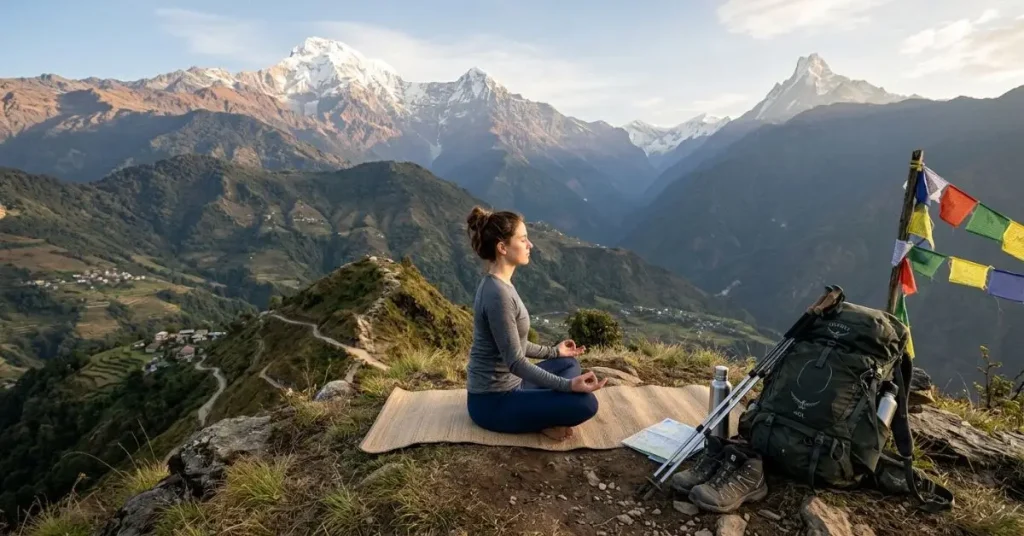
A common misconception is that Nepal Wellness Year 2027 signals a move away from trekking and adventure travel. That is not accurate. Officials have described the strategy as expanding Nepal’s tourism portfolio, not replacing its existing one. Trekking, mountaineering, and cultural tourism remain central to Nepal’s economy and identity. Wellness tourism is being layered on top as an additional, higher-spending segment, and in regions like Mustang and Manang, the strategy explicitly blends wellness with trekking rather than separating the two.
For travelers, this means you do not have to choose between “a Nepal trekking trip” and “a Nepal wellness trip” as mutually exclusive categories. A growing number of itineraries are expected to combine both, especially in the mid-hills and lower Himalayan regions.
How to Practice Responsible Wellness Tourism in Nepal
As wellness tourism grows, the same responsible travel principles that apply to trekking apply here too:
- Respect the cultural and religious roots of the practices you are engaging with. Yoga, meditation, and Ayurveda have deep cultural and spiritual significance in Nepal. Treat them accordingly rather than purely as leisure activities.
- Support locally run wellness providers where possible, since the strategy’s stated goal is for a meaningful share of new jobs to benefit local communities, women, and youth.
- Ask questions about practitioner training, particularly for Ayurveda and yoga instruction, until formal certification standards are fully implemented.
- Be mindful in shared natural spaces like Nagarkot, Dhulikhel, and lakeside Pokhara, which are also everyday living environments for local residents.
| Responsible Travel: Choosing wellness providers that are transparent about practitioner qualifications supports the same trust-building goals the national strategy is working toward. |
Nepal Wellness Year 2027: What Travelers Should Know
Nepal Wellness Year 2027 is a genuine, government-backed effort to expand Nepal’s tourism identity beyond trekking and adventure travel, built on a 10-year National Wellness Tourism Strategy and real, if still-developing, infrastructure. For travelers, the practical takeaway is this: 2027 is a good year to explore Nepal’s wellness offerings, but it is still early. Certification standards and provider quality checks are only expected to be fully in place by the end of the year, so a degree of independent research still matters.
Wander Himalayan will continue tracking how this initiative develops across Nepal’s destinations, from Pokhara to Mustang, as part of our ongoing coverage of Nepal travel planning and Nepal’s regions. If you’re weighing a wellness-focused trip against a trekking-focused one, our Nepal destinations guides are a useful starting point for seeing where the two increasingly overlap.
Frequently Asked Questions
1. What is Nepal’s wellness tourism strategy?
Nepal’s wellness tourism strategy is the National Wellness Tourism Strategy (2026-2035), paired with a five-year action plan (2026-2030), developed by the Ministry of Culture, Tourism, and Civil Aviation. It focuses on four sectors, including spa and massage, Ayurveda, yoga and meditation, and natural healing, with a goal of wellness tourists making up 11% of Nepal’s international arrivals by 2030.
2. When did Nepal announce Wellness Year 2027?
Nepal announced Wellness Year 2027 on April 15, 2026, during the country’s first observance of International Wellness Day, at an event held at Sainik Manch, Tundikhel in Kathmandu.
3. What is International Wellness Day and why is it on April 15?
International Wellness Day is a UN-recognized observance held every April 15, created through a resolution Nepal proposed and the UN General Assembly adopted on March 10, 2026. Nepal selected April 15 as the annual date and used its first observance to launch Nepal Wellness Year 2027.
4. Why is Nepal shifting from adventure tourism to wellness tourism?
Nepal is not fully shifting away from adventure tourism. It is adding wellness tourism alongside it. The government’s stated reasoning includes diversifying tourism revenue, tapping into high-value travelers who spend more than average tourists, and building on the diplomatic momentum from its UN wellness day resolution.
5. What wellness experiences does Nepal offer (yoga, Ayurveda, meditation, trekking)?
Nepal offers yoga and meditation retreats (concentrated around Pokhara, Kathmandu, and Lumbini), Ayurveda clinics and treatments, spa and massage services, and natural healing experiences tied to its mountain and rural landscapes. Several regions, like Mustang and Manang, are developing wellness programs that combine these practices with trekking.
6. What are the best wellness retreats in Nepal?
Nepal doesn’t yet have a single certified list of “best” wellness retreats, since national quality standards are still being finalized through 2027. Dwarika’s Sanctuary near Kathmandu and Shinta Mani Mustang in Upper Mustang are commonly cited as examples of established, high-end wellness hospitality already operating in the country.
7. Is Nepal Wellness Year 2027 a government program or a marketing campaign?
It is both. It is an official government initiative led by the Nepal Tourism Board and the Ministry of Culture, Tourism, and Civil Aviation, backed by a formal national strategy, but it also functions as an international marketing campaign designed to raise Nepal’s profile as a wellness destination.
8. Does Nepal have a wellness tourism certification system?
Not yet fully. A National Wellness Standards and Code of Conduct is planned for implementation by the end of 2027, meaning travelers booking wellness services in the meantime should verify providers independently rather than assuming certification already applies.
9. How many wellness tourists does Nepal expect by 2027?
Under the strategy’s phased targets, Nepal aims to attract 500 to 1,000 foreign wellness tourists during the 2026-27 pilot phase, scaling to 3,000 to 5,000 by 2028-29, and more than 10,000 annually after 2030.
10. Which regions of Nepal are prioritized for wellness tourism?
The strategy prioritizes the Kathmandu Valley, Pokhara, Lumbini, Nagarkot, Dhulikhel, Mustang, and Manang, with plans for at least five integrated wellness hubs nationally.
11. Can I combine trekking with a wellness trip to Nepal in 2027?
Yes. The national strategy explicitly designs some regions, particularly Mustang and Manang, around combining wellness practices with trekking and mountain environments, rather than treating them as separate categories of travel.
Sources and Official References
- Nepal Tourism Board: Nepal Unveils Wellness Tourism Vision, Announces Nepal Wellness Year 2027
- Ratopati: Nepal Launches National Wellness Tourism Strategy and Action Plan
- IANS Live: Nepal Aims to Develop Wellness Tourism as Key Pillar of Tourism Industry
- New Business Age: Government Unveils 10-Year National Wellness Tourism Strategy
Sandeep Poudel is the founder of Wander Himalayan and a lifelong traveler with a deep interest in Nepal’s mountains, culture, landscapes, and local communities. His interest in exploring Nepal began early in life and has grown into a passion for discovering places beyond the usual tourist routes and understanding what makes each destination unique.
From detailed trekking guides and packing advice to destination guides, travel costs, transportation, and local insights, Sandeep focuses on information that travelers can actually use when planning a trip.