
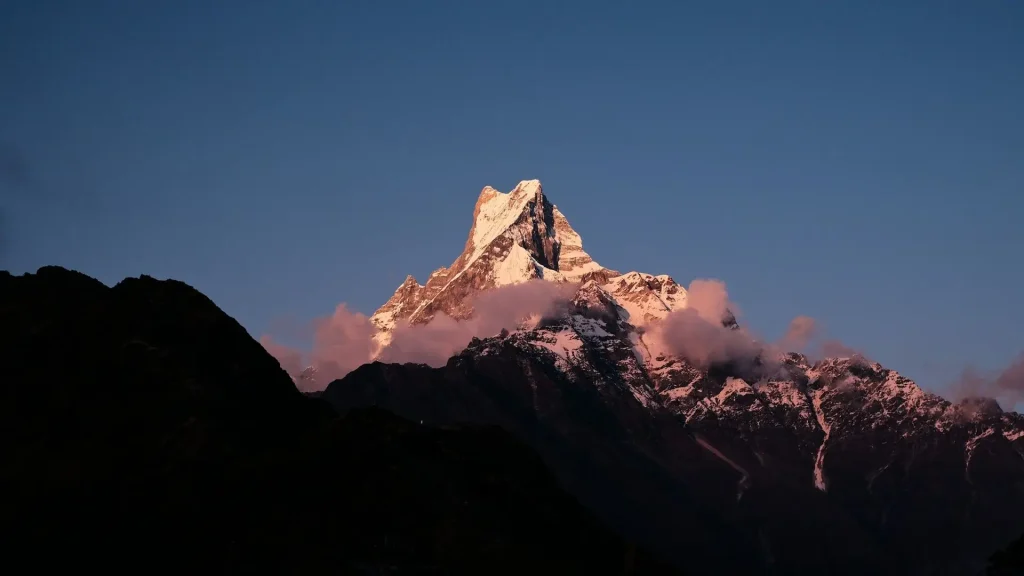
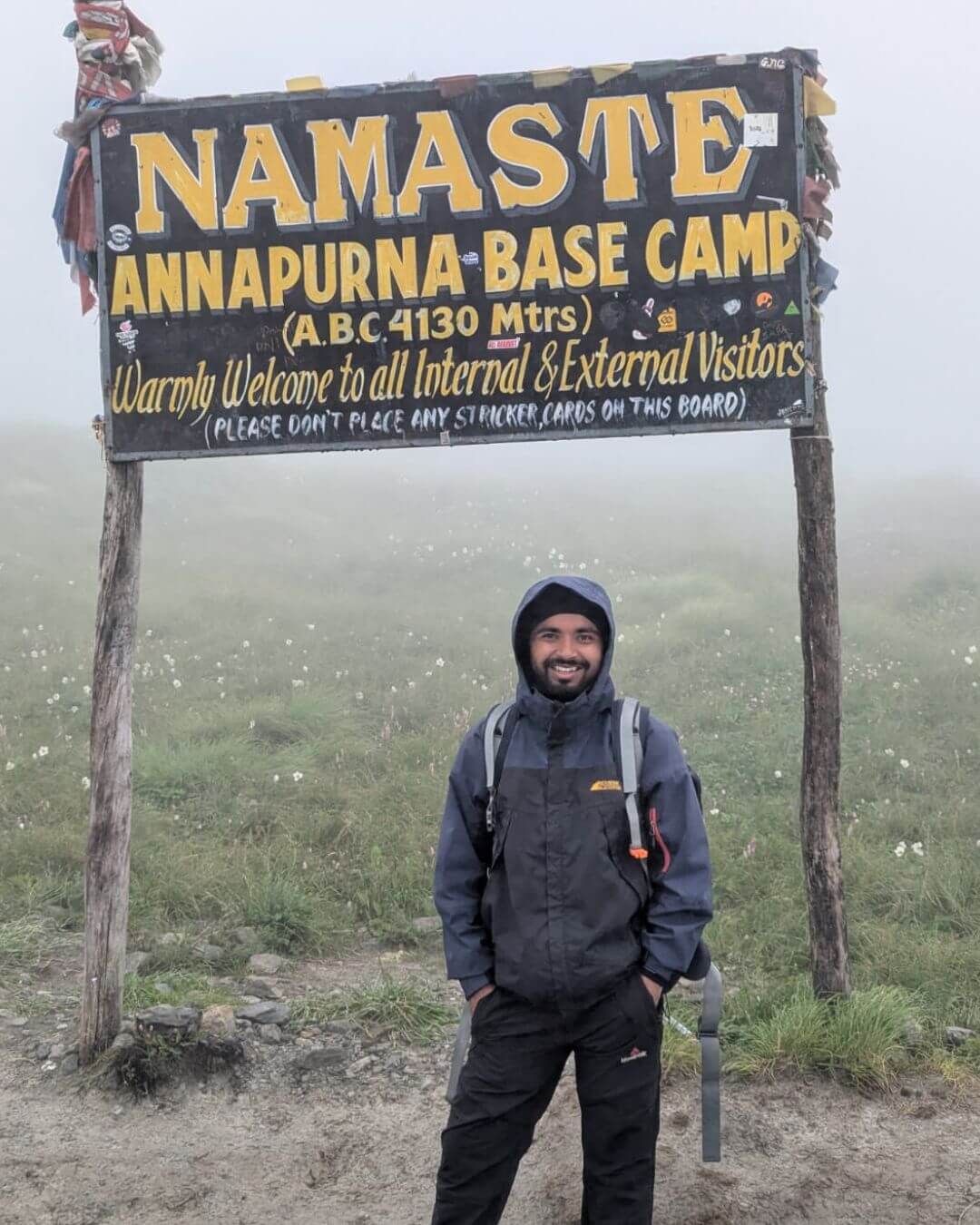
If you want big Himalayan views without committing two weeks to Annapurna Base Camp or Everest Base Camp, the Mardi Himal Trek is one of the most rewarding short treks in Nepal. Tucked onto a ridge south of the main Annapurna Sanctuary route, it climbs through rhododendron forest and Gurung villages before opening onto a close-up view of Machhapuchhre and the wider Annapurna massif.
This guide walks through the route, how long the trek takes, how difficult it is, when to go, what permits you need, and what the trail is actually like, so you can decide whether it fits your trip to Nepal.
| Quick Answer The Mardi Himal Trek is a 5 to 7 day teahouse trek in Nepal’s Annapurna region, starting near Kande, about 45 minutes from Pokhara by road. Most itineraries reach Mardi Himal Upper Viewpoint (around 4,200-4,250 m), and stronger groups continue to Mardi Himal Base Camp (4,500 m) if trail and weather conditions allow. Round-trip walking distance runs roughly 40-45 km. The trek is rated moderate and suits reasonably fit trekkers with some prior hiking experience, walking with a licensed guide as current Nepal trekking rules require. |
Key Takeaways
- One of the shortest treks in the Annapurna region that still climbs above 4,000 m.
- Most trekkers finish it in 5 to 7 days round trip from Pokhara.
- Quieter than Annapurna Base Camp or Poon Hill, even in peak season.
- Highest points: Upper Viewpoint (~4,200-4,250 m) and Base Camp (4,500 m).
- Reaching Base Camp depends on snow and trail conditions.
- Best mountain views: spring (March-May) and autumn (September-November).
- An ACAP permit is mandatory; a licensed guide is required by current regulations.
- No technical climbing, but the final stretch above High Camp is steep and exposed.
Table of Contents
What Is the Mardi Himal Trek?
The Mardi Himal Trek is a teahouse trek in Nepal’s Annapurna Conservation Area that follows a forested ridge toward Mardi Himal, a 5,587 m peak sitting directly beneath Machhapuchhre, also known as Fishtail Mountain. Unlike the Annapurna Base Camp trail, which follows the Modi Khola valley floor into the Annapurna Sanctuary, the Mardi Himal route stays on a ridge to the east, climbing through rhododendron and oak forest before breaking above the treeline near High Camp.
The trek sits within the wider Annapurna region, one of the most visited trekking areas in Nepal, and it’s often chosen by travelers who want a genuine high-altitude Himalayan view without the time or altitude commitment of the full Annapurna Circuit or Annapurna Base Camp Trek. Because the ridge runs close to Machhapuchhre, trekkers get some of the closest views of the mountain available on any route that doesn’t require a restricted-area permit.
Along the way, the route passes through Australian Camp, Pitam Deurali, Forest Camp, Low Camp, Badal Danda, and High Camp before reaching the Upper Viewpoint and, conditions permitting, Base Camp. Several of these stops are seasonal herding camps or small teahouse clusters rather than permanent villages, which is part of why the trail feels quieter than busier Annapurna routes even in peak season.
Mardi Himal Trek Route: Stage by Stage
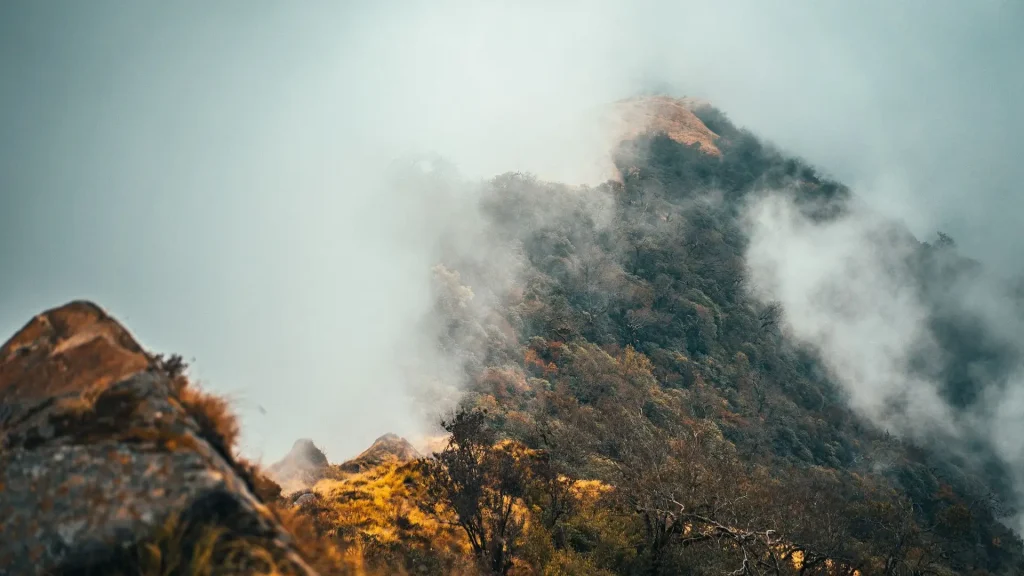
The standard Mardi Himal Trek route runs from Kande, near Pokhara, up through Forest Camp, Low Camp, Badal Danda, and High Camp to the Upper Viewpoint and Base Camp, then back down through Siding to a road pickup point. Most itineraries walk this as a loop rather than retracing the entire ascent.
| Stage | Approx. Altitude | Notes |
| Kande | 1,770 m | Trailhead, about 45 minutes by road from Pokhara |
| Australian Camp | 2,050 m | Popular short-stay viewpoint on the lower trail |
| Pitam Deurali | 2,100 m | Junction point toward Forest Camp |
| Forest Camp | 2,550 m | First overnight stop on most itineraries |
| Low Camp | 2,970 m | Rhododendron and oak forest thins out above here |
| Badal Danda | 3,210 m | Treeline transition, open ridge views begin |
| High Camp | 3,580 m | Highest regular overnight stop |
| Mardi Himal Upper Viewpoint | ~4,200-4,250 m | Highest point most trekkers reach |
| Mardi Himal Base Camp | ~4,500 m | Reached when trail and weather allow |
| Siding | 1,700 m | Descent route back to road transport |
The lower trail winds through dense rhododendron and oak forest that turns bright red and pink in spring, then thins into juniper scrub and alpine grass above Badal Danda. From High Camp, the path to the Upper Viewpoint follows a narrow ridge with drop-offs on both sides, which is the most exposed and, in poor visibility or fresh snow, the most demanding section of the entire trek.
Comparing your options for a Himalayan adventure? Discover more trekking in Nepal and find a route that matches your time and experience.
How Long Is the Mardi Himal Trek?
Most trekkers complete the Mardi Himal Trek in 5 to 7 days round trip from Pokhara, including the drive to Kande and the drive back from Siding. Fit trekkers on a tight schedule sometimes compress it into 4 days, while itineraries with an extra acclimatization day or a slower pace stretch to 7 or 8 days.
Sample 5-Day Mardi Himal Trek Itinerary
| Day | Route | Approx. Walking Time |
| Day 1 | Pokhara → Kande (drive) → Forest Camp | 4-5 hours trekking |
| Day 2 | Forest Camp → High Camp | 6-7 hours trekking |
| Day 3 | High Camp → Upper Viewpoint / Base Camp → back to High Camp | 4-6 hours trekking |
| Day 4 | High Camp → Siding | 5-6 hours trekking |
| Day 5 | Siding → Pokhara (drive) | 2-3 hours driving |
| Good to Know Itinerary length is flexible. Adding a day at Low Camp or High Camp builds in extra acclimatization time and gives you a backup weather day for the push to the Upper Viewpoint. |
How Difficult Is the Mardi Himal Trek?
The Mardi Himal Trek is rated moderate. It doesn’t require technical climbing or a high mountain pass, but daily walks of 4 to 7 hours, a steady climb from around 1,770 m to as high as 4,500 m, and a steep, sometimes icy final section above High Camp make it noticeably harder than an easy day-hike itinerary.
| Difficulty Factor | What to Expect |
| Daily walking hours | 4-7 hours, more on the Base Camp/Viewpoint push |
| Elevation gain | From 1,770 m to as high as 4,500 m over 3-4 ascent days |
| Trail surface | Forest trail and stone steps lower down; rocky, exposed ridge above High Camp |
| Altitude effect | Possible from around High Camp upward; most trekkers feel some effect near the Upper Viewpoint |
In practice, the trek’s difficulty comes less from any single hard day and more from the combination of sustained daily walking, cold temperatures at High Camp, and the thin air above 4,000 m. Trekkers who arrive with some hiking fitness usually find the pace manageable; those with none often find the final day tougher than expected.
Is Mardi Himal or ABC Harder?
Mardi Himal is generally considered the shorter and less demanding of the two treks overall, even though its highest points sit at or above Annapurna Base Camp’s altitude. The Annapurna Base Camp (ABC) Trek takes longer, covers more distance, and involves more consecutive high-altitude walking days, while Mardi Himal reaches a comparable or slightly higher altitude in a shorter overall trip.
| Factor | Mardi Himal Trek | Annapurna Base Camp Trek |
| Typical duration | 5-7 days | 7-12 days |
| Max altitude | ~4,500 m (Base Camp) | ~4,130 m (Base Camp) |
| Round-trip distance | ~40-45 km | ~60-115 km, depending on route |
| Crowds | Quiet, even in peak season | Busier, especially October-November |
| Terrain | Ridge walk, steep exposed final stretch | Valley trail, steady stone steps, hot springs at Jhinu |
Neither trek involves technical climbing, but ABC demands more sustained walking days at altitude, while Mardi Himal packs a similar high-altitude payoff into a shorter, steeper push. Trekkers choosing between the two often pick Mardi Himal for a shorter trip or a quieter trail and ABC for the classic sanctuary views and hot-spring finish at Jhinu Danda.
Can Beginners Complete Mardi Himal Trek Safely?
Yes, most first-time trekkers with reasonable fitness can complete the Mardi Himal Trek, provided they walk at a steady pace, follow their guide’s advice on acclimatization, and don’t push through symptoms of altitude sickness. Some hiking or regular cardio fitness beforehand makes the daily walking hours and the final steep stretch noticeably more comfortable.
- Build up general fitness with regular walking, hiking, or cardio in the weeks before the trek.
- Break in trekking boots well before arriving in Nepal.
- Walk at your own pace rather than matching a faster group member.
- Tell your guide immediately about headaches, nausea, or unusual fatigue above High Camp.
| Safety Note Altitude sickness can affect fit and inexperienced trekkers alike, and it isn’t fully predictable. Watch for headache, nausea, dizziness, or unusual fatigue, especially above High Camp, and descend if symptoms don’t improve with rest. No itinerary or guide can guarantee against altitude illness. |
Which Month Is Best for Mardi Himal Trek?
Autumn, from late September through November, is generally considered the best time for the Mardi Himal Trek, thanks to stable weather and the clearest mountain visibility. Spring, from March through May, is a close second and adds blooming rhododendron forest along the lower trail.
| Season | Months | Conditions |
| Spring | March-May | Warm days, cold nights at High Camp, rhododendrons in bloom, generally clear mornings |
| Autumn | September-November | Most stable weather of the year, driest trails, clearest visibility, busiest season |
| Winter | December-February | Cold, possible snow at High Camp and above, quiet trails, often very clear at dawn |
| Monsoon | June-August | Heavy rain, leeches on the lower forest trail, poor visibility; generally not recommended |
Mardi Himal Trek Permits
Every foreign trekker needs the Annapurna Conservation Area Permit (ACAP) to trek Mardi Himal, since the entire route lies inside the Annapurna Conservation Area. Nepal’s 2023 trekking regulations also require foreign trekkers to travel with a licensed guide rather than fully independently, and many guided groups arrange a TIMS (Trekkers’ Information Management System) card as well.
| Permit | Cost (Foreign Trekkers) | Issued By |
| ACAP (Annapurna Conservation Area Permit) | NPR 3,000 (approx. USD 22-25) | National Trust for Nature Conservation (NTNC) |
| TIMS Card | Approx. NPR 2,000 (often less when arranged through a registered agency) | Nepal Tourism Board (NTB) / TAAN |
| Important TIMS requirements for the Annapurna region have shifted more than once in recent years, and enforcement varies by checkpoint. Confirm the current requirement with the Nepal Tourism Board or your guide company before you travel, and carry printed permits since remote checkpoints don’t always have working internet access for digital verification. |
Getting to the Mardi Himal Trailhead
The Mardi Himal Trek starts from Kande, a small roadside settlement about 45 minutes to an hour by car or shared jeep from Pokhara’s Lakeside area. Most guided trekkers arrange a private vehicle or shared jeep the morning the trek begins, rather than a public bus, since it’s faster and drops trekkers directly at the trailhead.
Almost everyone flies or drives into Pokhara first, usually from Kathmandu, before starting the trek. On the return leg, transport picks trekkers up at Siding or Lumre and drives back to Pokhara, closing the loop. Given the short drive times on both ends, most 5-day itineraries lose less than half a day total to transport.
Mardi Himal Trek Cost
A guided Mardi Himal Trek typically costs somewhere between USD 300 and USD 700 per person for a standard 5- to 7-day trip, depending on group size, season, and what’s included. Independent budget trekking with a locally hired guide and basic teahouse stays tends to come in at the lower end; itineraries with private transport and higher-standard lodges cost more.
| Cost Category | Typical Range (per person) |
| Permits (ACAP + TIMS) | USD 37-45 total |
| Guide | USD 25-35 per day |
| Teahouse accommodation | USD 5-15 per night (often discounted against meal orders) |
| Meals | USD 20-30 per day |
| Pokhara-Kande-Siding transport | USD 15-30 total |
| Budget Tip Meal and room prices rise gradually with altitude, since everything above Forest Camp has to be carried in by a porter or mule. Budgeting a little extra for high camp meals avoids surprises on your final overnight before the summit push. |
These figures are general planning ranges rather than fixed prices, and they change with fuel costs, season, and exchange rates. Get a current quote from a licensed Nepali trekking company or guide before booking, since Wander Himalayan is an independent travel information platform and doesn’t sell or operate treks.
Mountain Views and Landmarks Along the Mardi Himal Trail
The main reason trekkers choose Mardi Himal is the mountain scenery, which opens up dramatically once the trail clears the treeline near Badal Danda. From High Camp, the Upper Viewpoint, and Base Camp, the panorama includes Machhapuchhre rising almost directly overhead, along with Annapurna South, Hiunchuli, and the broader Annapurna Massif stretching along the horizon.
Machhapuchhre, meaning ‘Fishtail’ for its twin-peaked summit, is considered sacred in local Gurung and Hindu tradition and has never been officially climbed to its true summit. Because the Mardi Himal ridge sits almost directly south of the mountain, trekkers here get a noticeably closer, more front-on view of Machhapuchhre than is possible from the main Annapurna Base Camp trail.
To the west, the view opens onto the wider Annapurna Massif, the cluster of peaks that gives the whole region its name. On a clear morning from High Camp or the Upper Viewpoint, that panorama typically takes in Annapurna South and Hiunchuli in the foreground, with the rest of the Annapurna Massif layered behind them, a sweep of high peaks that most short treks in Nepal simply don’t get close enough to see this clearly.
Gurung Villages and Local Culture in Mardi Himal Trekking
The lower and final stages of the trek pass through communities in the Gurung heartland of the Annapurna foothills, including villages around Kande and Siding. Gurung culture is closely tied to the mountains, with a long history of mountaineering and Gurkha military service, and many teahouses along the trail are family-run by local Gurung households.
Higher up, the trail’s camps are more functional than cultural, built primarily to serve trekkers rather than as settled villages, so most of the cultural experience on this route is concentrated in the lower stages near Kande and Siding rather than spread evenly across the whole trek.
Where to Stay: Teahouses on the Mardi Himal Trail
Accommodation along the Mardi Himal route is entirely in teahouses, simple family-run lodges offering a basic room, shared or squat-style toilets, and a communal dining area heated by a wood or gas stove in the evening. Rooms at lower camps like Forest Camp and Low Camp tend to be more comfortable, while High Camp lodges are more basic, with thinner walls and colder nights.
Most teahouses expect guests to order meals on-site in exchange for a low or free room rate, which is standard practice across Nepal’s trekking regions and helps support the family running the lodge.
How to Prepare for the Mardi Himal Trek
Physical preparation matters more on Mardi Himal than the modest distance might suggest, mainly because of the steep, sustained climbing on the middle days. Trekkers who spend four to six weeks before departure building up walking endurance and leg strength typically find the trek considerably more enjoyable than those who arrive without any training.
- Walk regularly on hilly terrain or stairs, gradually increasing distance and pack weight over several weeks.
- Add cardio sessions such as running, cycling, or swimming to build overall stamina.
- Do a few practice hikes carrying a loaded daypack, similar to what you’ll carry on the trail.
- Talk to a doctor about altitude sickness medication if you have a relevant medical history or are trekking above 4,000 m for the first time.
What to Pack for the Mardi Himal Trek
Because the trek moves from subtropical forest to alpine ridge in a matter of days, layering is more important than any single piece of gear. A practical packing list covers warmth, sun protection, and basic self-sufficiency for a trail with limited services above Forest Camp.
- Insulated jacket and a warm layer for high camp nights, which regularly drop below freezing outside peak summer months.
- Sturdy, broken-in trekking boots and trekking poles for the steep, sometimes loose final ascent.
- Headlamp for early starts toward the Upper Viewpoint or Base Camp.
- Sun hat, sunglasses, and high-SPF sunscreen, since UV exposure increases sharply with altitude.
- Water bottle or bladder plus a reliable purification method, such as tablets or a filter.
- Basic first-aid kit and any personal medication, including altitude sickness medication if prescribed by your doctor.
- Cash in Nepali rupees for permits, snacks, and teahouse extras; card payments aren’t available on the trail.
Safety and Responsible Trekking
Altitude, weather, and terrain are the three main safety considerations on Mardi Himal. The route doesn’t reach extreme altitude, but 4,200-you4,500 m is high enough for altitude sickness to be a real possibility, and the exposed ridge above High Camp can turn dangerous quickly in fog, wind, or fresh snow.
| Safety Note Trekking with a licensed guide, as current regulations require, gives you someone experienced in reading trail and weather conditions and making the call on whether to push to the Upper Viewpoint or Base Camp on a given day. No guide, itinerary, or gear list can eliminate the risks of high-altitude trekking, so always be prepared to turn back. |
| Responsible Travel Carry out everything you carry in, refill water bottles rather than buying single-use plastic where possible, and stick to marked trails to avoid damaging fragile alpine vegetation above the treeline. Hiring a local guide and porter also puts trekking income directly into Gurung communities along the route. |
Common Mistakes to Avoid
- Skipping a rest or buffer day and pushing straight through to Base Camp on a tight schedule, leaving no room for bad weather.
- Underestimating how cold High Camp and the Upper Viewpoint get, even in spring and autumn.
- Ignoring a guide’s decision to turn back from the summit push due to weather or trail conditions.
- Arriving without any prior hiking or cardio fitness and expecting the final day to feel easy.
- Forgetting to carry Nepali rupees in cash for permits and trailside costs.
Alternatives to Mardi Himal
Trekkers deciding between Annapurna region routes often compare Mardi Himal with Ghorepani Poon Hill, a shorter and gentler trek topping out around 3,210 m, or with the longer Annapurna Base Camp Trek and Annapurna Circuit Trek for a more extensive mountain experience. Mardi Himal sits between these in difficulty, offering higher altitude and more solitude than Poon Hill without the full-time commitment of ABC or the Circuit.
For a broader look at how these routes compare, see Wander Himalayan’s guides to the Annapurna region and the Annapurna Base Camp Trek, or the Pokhara travel guide for planning the city side of your trip.
Final Thoughts
The Mardi Himal Trek delivers close-up Annapurna views, a genuine high-altitude experience, and a quiet trail, all within a 5- to 7-day trip from Pokhara.
It suits travelers who want the payoff of a high Himalayan viewpoint without the time commitment of Annapurna Base Camp or the Annapurna Circuit, provided they come prepared for cold nights, a steep final push, and the basic realities of altitude.
Frequently Asked Questions
1. How long is the Mardi Himal trek?
The Mardi Himal Trek typically takes 5 to 7 days round trip from Pokhara, including the drive to Kande and back from Siding. Faster itineraries compress it to 4 days, and slower-paced trips with extra acclimatization run 7 to 8 days.
2. How difficult is the Mardi Himal trek?
The Mardi Himal Trek is rated moderate difficulty. It involves 4 to 7 hours of walking most days, a climb from around 1,770 m to as high as 4,500 m, and a steep, exposed final stretch above High Camp, but no technical climbing or high mountain pass.
3. Is Mardi Himal or ABC harder?
Annapurna Base Camp (ABC) is generally the more demanding trek overall, mainly because of its longer duration and greater total distance, even though Mardi Himal reaches a comparable or slightly higher maximum altitude in a shorter trip.
4. Can beginners complete Mardi Himal trek safely?
Beginners with reasonable fitness can usually complete the Mardi Himal Trek, especially when walking with a licensed guide at a steady pace and taking altitude symptoms seriously. Some prior hiking or cardio training makes the trek considerably more comfortable.
5. Which season is best for Mardi Himal trek?
Autumn, from late September through November, is usually considered the best month for the Mardi Himal Trek because of stable weather and clear mountain views. Spring, from March to May, is a close second and adds blooming rhododendron forest.
6. Do I need a guide for the Mardi Himal trek?
Yes. Current Nepal government regulations require foreign trekkers to trek with a licensed guide rather than fully independently, including on the Mardi Himal route.
7. What permits do I need for the Mardi Himal trek?
Every foreign trekker needs the Annapurna Conservation Area Permit (ACAP), since the route lies entirely inside the Annapurna Conservation Area. Many guided trekkers also arrange a TIMS card; requirements have shifted in recent years, so confirm current rules with the Nepal Tourism Board or your guide company.
8. How much does the Mardi Himal trek cost?
A guided 5- to 7-day Mardi Himal Trek typically costs between USD 300 and USD 700 per person, covering permits, a guide, teahouse accommodation, meals, and transport between Pokhara, Kande, and Siding.
9. What is the highest point of the Mardi Himal trek?
The highest point of the Mardi Himal Trek is Mardi Himal Base Camp, at approximately 4,500 m. Many trekkers stop instead at the Upper Viewpoint, around 4,200 to 4,250 m, when trail or weather conditions make Base Camp impractical.
10. Is there mobile signal or wifi on the Mardi Himal trail?
Mobile signal and wifi become patchy above Forest Camp and largely unreliable from High Camp upward. Some teahouses offer paid wifi lower on the trail, but connectivity should not be relied on for the upper stages.
11. Can altitude sickness be a problem on Mardi Himal?
Altitude sickness is a real possibility above roughly 3,500 m, which includes High Camp, the Upper Viewpoint, and Base Camp. Watch for headache, nausea, or dizziness, and descend if symptoms don’t improve with rest.
12. Can Mardi Himal be combined with other treks?
Some itineraries combine Mardi Himal with a short extension toward Annapurna Base Camp or with time in Pokhara and Ghorepani Poon Hill, though this extends the total trip length considerably and needs careful planning with a guide.
Sources:
- National Trust for Nature Conservation (NTNC): ACAP e-permit system https://epermit.ntnc.org.np/
- Nepal Tourism Board: Trekking Permit Information https://ntb.gov.np/plan-your-trip/before-you-come/trekking-permit