If you’re planning the trek to Annapurna Base Camp, permits are one of the first things to sort out, right after choosing your dates. Annapurna Base Camp trek permits currently mean two documents: the Annapurna Conservation Area Permit (ACAP) and a Trekkers’ Information Management System (TIMS) card. Both are mandatory, both are tied to a 2023 rule change that also made a licensed guide compulsory on this route, and getting the details wrong at a checkpoint can mean fines or a forced turnaround.
This guide breaks down exactly what each permit costs in 2026, who needs to pay what, which documents you need to apply, and where to collect everything in Kathmandu or Pokhara, whether you’re trekking independently with a guide or joining an organized group.
Quick Answer
Annapurna Base Camp trek permits cost NPR 5,000 (roughly $32-$35) per foreign trekker in 2026: NPR 3,000 for the Annapurna Conservation Area Permit (ACAP) and NPR 2,000 for the TIMS card. SAARC nationals, including Indians, pay less: NPR 1,000 for ACAP and NPR 1,000 for TIMS, around NPR 2,000 total. Since 2023, for the ABC route, trekkers must follow the current TIMS and guide requirements applicable to the route, with TIMS issued through a government-registered trekking agency and a licensed guide required.
Annapurna Base Camp Trek Permits: Key Takeaways
- Two permits are required for Annapurna Base Camp: ACAP (NPR 3,000 for non-SAARC foreigners, NPR 1,000 for SAARC nationals) and TIMS (NPR 2,000 for non-SAARC foreigners, NPR 1,000 for SAARC nationals).
- Children under 10 do not need an ACAP permit.
- A licensed guide is required for trekkers on the ABC route under the current TIMS/guide rules.
- ACAP can be applied for online through the official NTNC e-permit portal; TIMS on this route is issued only through a government-registered trekking agency.
- Permits are checked at trail checkpoints such as Ghandruk, Chhomrong, and Sinuwa. Carry your permit and identification documents while trekking, as they may be checked at designated checkpoints.
- Permits obtained at a checkpost instead of in advance cost double, so arrange yours in Kathmandu or Pokhara before you start walking.
What Permits Do You Need for Annapurna Base Camp?
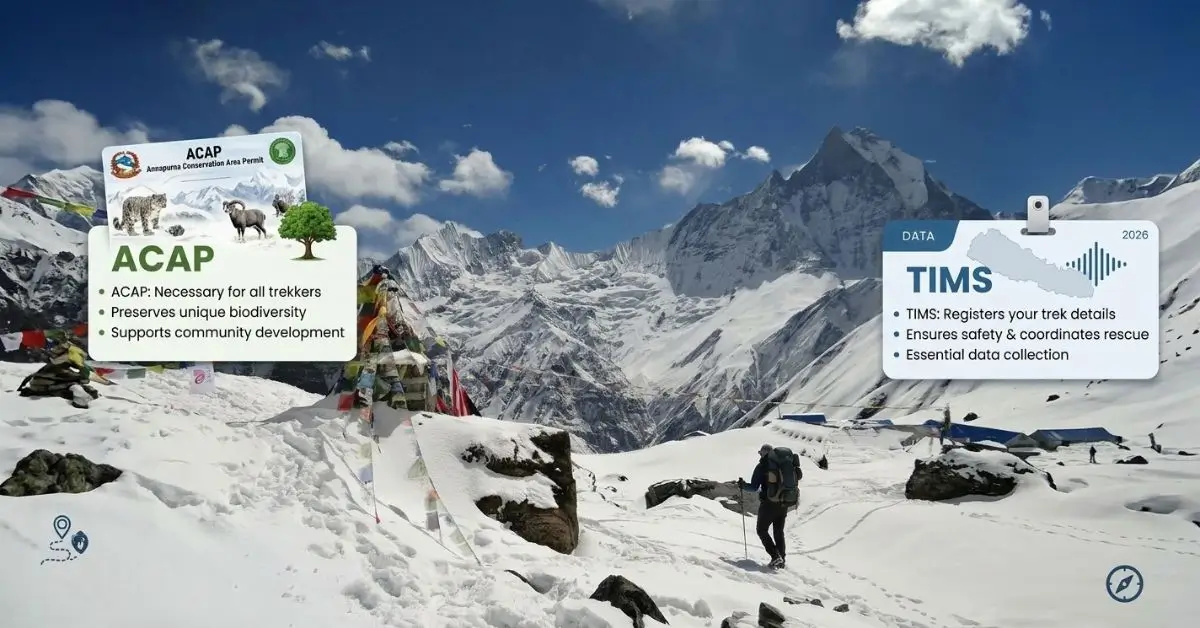
For the Annapurna Base Camp route, you need an Annapurna Conservation Area Permit (ACAP) and a TIMS card. The current TIMS rules also require trekkers on this route to use a licensed guide through a government-registered trekking agency.
1. Annapurna Conservation Area Permit (ACAP)
This is the entry fee for the Annapurna Conservation Area, Nepal’s largest protected area at roughly 7,629 square kilometers. It’s issued by the National Trust for Nature Conservation (NTNC), the semi-governmental body that has managed the area since 1986. Money from ACAP funds trail maintenance, drinking water systems, and community projects in villages like Ghandruk and Chhomrong along the route.
2. TIMS Card (Trekkers’ Information Management System)
TIMS (Trekkers’ Information Management System) records trekkers for safety and tracking purposes. Under the revised TIMS provision introduced in 2023, the Nepal Tourism Board requires TIMS and a licensed guide on specified trekking routes, including the Poon Hill-ABC route. For the ABC trek, TIMS is obtained through a government-registered trekking agency.
3. Guide requirement for
For the ABC route, a licensed guide is required under Nepal’s current TIMS rules. The Nepal Tourism Board’s current list of routes subject to the revised TIMS provision includes the Poon Hill-ABC Trek. TIMS must be obtained through a government-registered trekking agency, which arranges the required guide.
Annapurna Base Camp Permit Cost 2026
Here’s what you’ll actually pay. ACAP costs NPR 3,000 for foreign nationals and NPR 1,000 for SAARC nationals; TIMS costs NPR 2,000 for foreign trekkers and NPR 1,000 for SAARC nationals. Combined, that’s NPR 5,000 (about $32-$35 USD) for non-SAARC foreign trekkers and NPR 2,000 (about $13-$14 USD) for SAARC nationals, such as Indians and Bangladeshis.
| Permit | Foreign Nationals | SAARC Nationals | Children Under 10 |
|---|---|---|---|
| ACAP | NPR 3,000 (~$19-$20) | NPR 1,000 (~$6-$7) | Free |
| TIMS Card | NPR 2,000 (~$13-$14) | NPR 1,000 (~$6-$7) | Free |
| Total | NPR 5,000 (~$32-$35) | NPR 2,000 (~$13-14) | Free |
| Good to Know: ACAP fees are quoted in Nepalese rupees, not dollars, so the USD figure moves with the exchange rate. Use the rupee amount as the reliable number and treat the dollar conversion as approximate. |
Annapurna Base Camp Trek Permit Cost for Indians
Indian nationals qualify for the SAARC rate on both permits: NPR 1,000 for ACAP and NPR 1,000 for TIMS, a total of NPR 2,000, roughly $13 to $14. Indian citizens also do not need a separate Nepal visa to enter the country, but the guide requirement and permit process are otherwise identical to what other foreign trekkers follow.
Bring valid identification, such as your passport or another accepted Indian identity document, when applying.
What the ABC Permit Fees Actually Cover
The ACAP fee isn’t a formality. It’s the primary funding source for trail upkeep, ranger patrols, and community development inside the conservation area, including places you’ll pass through directly, like Ghandruk and Chhomrong. TIMS fees fund the tracking system that helps rescue teams locate trekkers in an emergency. Paying both on time and carrying the printed copies is part of trekking the region responsibly.
If you’re planning a wider trip around Nepal, our Nepal travel guide covers destinations, trekking routes, transportation, costs, and practical travel information to help you plan your journey.
Documents Required for Annapurna Base Camp Permits
Before you apply for Annapurna base camp trek permits, have these ready:
- Valid passport (original, plus a photocopy of the details page)
- Copy of your Nepal tourist visa
- Two recent passport-sized photographs
- Travel insurance details, including emergency evacuation coverage (your guide or agency will typically ask for this, even if it isn’t formally checked at the counter)
- Your trekking itinerary and entry/exit dates are needed to register with your guide’s agency for the TIMS card
| Quick Tip: Bring more passport photos than you think you need. Photocopiers and photo booths exist in Kathmandu and Pokhara, but having spares saves a trip back into town on a tight schedule. |
How to Get Annapurna Base Camp Trek Permits
You can apply for the ACAP online through the official NTNC e-permit portal or in person at an Nepal Tourism Board office in Kathmandu or Pokhara and get your TIMS card through the registered trekking agency that provides your mandatory guide.
Applying for ACAP Online
The NTNC runs an official e-permit portal at epermit.ntnc.org.np. You fill in your details, upload a photo, and pay by card. Two things to know before you start:
- Online payment carries an additional 2.9% payment gateway charge on top of the NPR 3,000 or NPR 1,000 fee.
- After payment, print the permit. Digital copies on your phone are not always accepted at remote trail checkpoints, and rangers scan the printed QR code against your passport at entry points like Ghandruk and Chhomrong.
Applying for ACAP and TIMS In Person/Offline
| Method | Where | What it is for |
|---|---|---|
| NTNC e-permit | Online | ACAP |
| NTNC entry permit counter | Kathmandu / Pokhara | ACAP |
| Registered trekking agency | Kathmandu / Pokhara | TIMS and guide arrangements |
If you book a guide through a registered agency, which is mandatory for ABC in 2026, the agency will typically arrange both permits as part of the booking and hand you the printed copies before you start trekking. This is the most common route for independent trekkers now that TIMS is issued only through agencies on this trail.
| Important: Getting a permit at a trail checkpost instead of in Kathmandu or Pokhara costs double the standard fee. Sort your paperwork before you leave the city. |
Where Are Permits Checked on the ABC Trail?
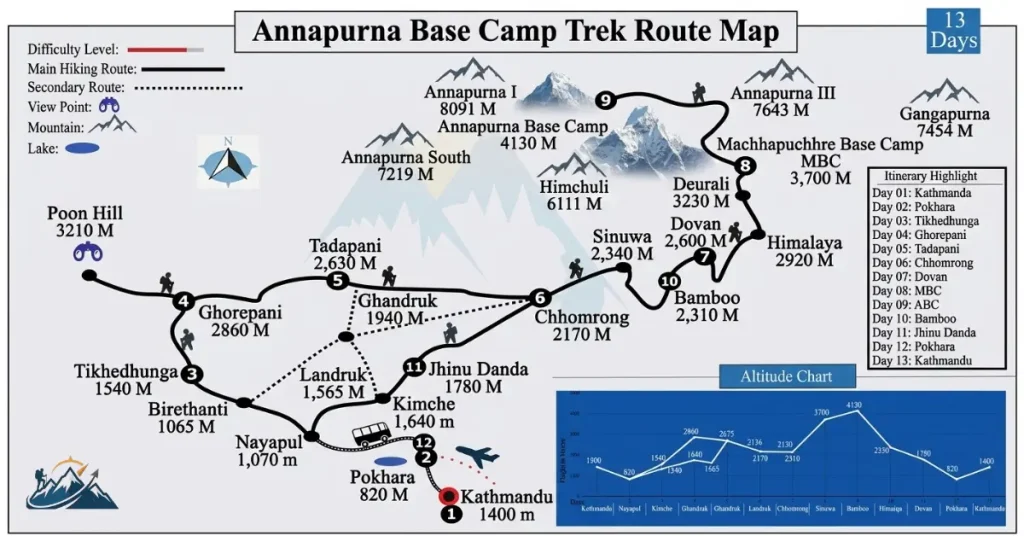
Expect checkpoints at the main entry points into the conservation area and again partway along the route, typically at or near Ghandruk (or Birethanti if you’re on the alternate approach), Chhomrong, and Sinuwa. Your permits and identification may be checked at designated checkpoints along the ABC route. Carry your permit and identification documents throughout the trek. With paperwork in order, this takes a couple of minutes. Without a valid permit, you risk an on-the-spot fine and being turned back before reaching the checkpoint’s onward trail.
Do You Need a Guide for Annapurna Base Camp?
Yes. As of the 2023 rule change, fully enforced through the 2026 season, every foreign trekker entering the Annapurna Conservation Area must be accompanied by a licensed guide from a government-registered trekking agency. This replaced the older system where independent trekkers could buy a TIMS card directly and walk the route alone. A licensed guide for ABC typically costs in the range of $25 to $35 per day, on top of the permit fees above.
| Local Insight: Guides on the ABC route generally speak workable English, know the current condition of teahouses and river crossings, and can flag altitude symptoms early, which matters more on ABC’s shorter, faster ascent profile than on longer treks like the Annapurna Circuit. |
Can You Get the Permit in Pokhara?
Yes. ACAP can be obtained through the NTNC entry permit system in Pokhara, including its Pokhara entry permit counter in the Damside area. Registered trekking agencies in Pokhara can also arrange TIMS and guide services for the ABC trek.
Common Permit Mistakes to Avoid
- Waiting until the trailhead. Arranging permits in Kathmandu or Pokhara is straightforward; doing it at a checkpost costs double and can delay your start.
- Not carrying your permit and identification. Keep your permit and valid identification accessible during the trek in case they are requested at checkpoints.
- Assuming TIMS is optional. Some older articles online still describe TIMS as discontinued for Annapurna. As of 2026, it’s required on this route, issued through your guide’s agency rather than sold to individuals directly.
- Skipping travel insurance. It isn’t always checked at the permit counter, but it matters if you need evacuation from altitude, and many guides and agencies will ask to see proof before departure.
- Forgetting children still need documentation. Kids under 10 don’t pay the ACAP fee, but you should still carry their passport details for the checkpoint log.
Responsible Travel on the ABC Trail
Your ACAP fee funds real conservation work in the villages you’ll walk through, so treating the trail with care matters as much as carrying the right paperwork. Stick to marked trails, carry out what you carry in, and avoid single-use plastic where refill stations are available in Ghandruk, Chhomrong, and other stops. Buying meals and snacks from local teahouses rather than packing everything from Kathmandu also keeps more of your trip’s spending inside the communities the conservation area supports.
Planning Your ABC Trek
Sorting out Annapurna Base Camp trek permits comes down to two documents, ACAP and TIMS, a licensed guide to travel with, and getting the paperwork done in Kathmandu or Pokhara before you reach the trailhead. Budget NPR 5,000 for permits if you’re a non-SAARC foreign national, or NPR 2,000 if you qualify for the SAARC rate, and build in your guide’s daily fee on top of that.
For more on planning the route itself, from itinerary length to acclimatization stops, see Wander Himalayan’s broader guides to trekking in the Annapurna region and the Annapurna Base Camp trek.
Frequently Asked Questions
How much does an Annapurna permit cost?
An Annapurna permit costs NPR 3,000 (about $19-$20) for the ACAP fee if you’re a foreign national, or NPR 1,000 if you’re a SAARC national. Add the TIMS card at NPR 2,000 (or NPR 1,000 for SAARC/group trekkers), and the combined cost for most foreign trekkers works out to NPR 5,000, roughly $32 to $35.
What permits are required for Annapurna Base Camp?
For the Annapurna Base Camp route, the required permits are ACAP and TIMS. The current TIMS rules also require the applicable guide arrangement through a registered trekking agency.
Do I need a TIMS card for the ABC trek?
Yes, a TIMS card is required for the ABC trek. Since the March 2023 rule change, it’s issued through a government-registered trekking agency together with your mandatory guide, rather than sold independently at an NTB counter.
Where can I get an Annapurna Base Camp permit?
ACAP can be obtained online through the NTNC e-permit portal or through an NTNC entry permit counter. TIMS for the ABC route is arranged through a government-registered trekking agency.
How much is the ACAP permit?
The ACAP permit costs NPR 3,000 for foreign nationals and NPR 1,000 for SAARC nationals, with children under 10 exempt. The fee is set in Nepalese rupees and includes tax.
Can I get the permit in Pokhara?
Yes. You can obtain the Annapurna Conservation Area Permit (ACAP) in Pokhara through the NTNC entry permit counter. You can also arrange the required TIMS and guide through a government-registered trekking agency in Pokhara before starting the ABC trek.
Do I need a guide for Annapurna Base Camp?
Yes, you need a guide for Annapurna Base Camp. Since April 1, 2023, all foreign trekkers must be accompanied by a licensed guide from a registered trekking agency to enter the Annapurna Conservation Area, and this rule remains fully enforced in 2026.
Can I apply for the Annapurna Base Camp trek permit online?
You can apply for the ACAP portion of your Annapurna Base Camp trek permit online through the official NTNC e-permit portal, with an added 2.9% payment gateway charge. The TIMS card isn’t available through a separate online application for individual trekkers; it’s issued through your registered guide’s agency.
Is the ACAP permit cost different for Indian trekkers?
Yes, Indian trekkers pay the SAARC rate: NPR 1,000 for ACAP and NPR 1,000 for TIMS, a combined NPR 2,000, roughly $13 to $14, compared to NPR 5,000 for most other foreign nationals.
What happens if I don’t have a permit at a checkpoint?
You may be required to show your trekking permit at check posts along the route. NTNC advises trekkers to carry their permit throughout the trip. If you obtain the ACAP permit directly at a checkpost, double the standard permit fee is charged.
Do children need a permit for Annapurna Base Camp?
Children below 10 years do not require an Annapurna Conservation Area entry permit. If a child is trekking on a route subject to the TIMS requirement, check the current TIMS arrangements with the registered trekking agency handling the trek.
Does the ACAP permit cover other Annapurna region treks too?
The ACAP entry permit is valid for a single entry into the Annapurna Conservation Area and covers designated destinations within the conservation area. NTNC lists routes and destinations, including the Annapurna Sanctuary (ABC), Ghorepani/Poon Hill, Mardi Himal, and the Annapurna Circuit under ACAP. If you plan to combine multiple routes, check that your itinerary remains within the designated ACAP area and complies with any separate TIMS or special-permit requirements.
Sandeep Poudel is the founder of Wander Himalayan and a lifelong traveler with a deep interest in Nepal’s mountains, culture, landscapes, and local communities. His interest in exploring Nepal began early in life and has grown into a passion for discovering places beyond the usual tourist routes and understanding what makes each destination unique.
From detailed trekking guides and packing advice to destination guides, travel costs, transportation, and local insights, Sandeep focuses on information that travelers can actually use when planning a trip.