Anyone researching the Annapurna Base Camp trek difficulty is usually asking one practical question: can I actually do this? Is the Annapurna Base Camp trek difficult, or is it something a reasonably fit beginner can handle? The good news is that Annapurna Base Camp (ABC) is widely considered one of the more achievable high-altitude treks in Nepal, but “achievable” doesn’t mean effortless. It involves several consecutive days of walking, a steady altitude gain to 4,130 meters, and long sections of stone steps that surprise even fit trekkers.
This guide breaks down exactly how hard the Annapurna Base Camp trek is, what makes it challenging, how it compares to other routes, and how to prepare so the difficulty works in your favor rather than against you.
| Quick Answer The Annapurna Base Camp trek difficulty level sits at moderate. It is challenging enough to require decent fitness and mental stamina, but not technical. It reaches 4,130 meters over roughly 7 to 9 days of trekking, covering approximately 70 to 115 km round trip depending on your starting point and route, through steep stone-stepped trails, river valleys, and rhododendron forest. No climbing skills or prior trekking experience are required, but daily walks of 5 to 7 hours and cumulative altitude gain make preparation genuinely important, especially for beginners tackling their first Himalayan trek. |
Annapurna Base Camp Trek Difficulty | Key Takeaways
- Annapurna Base Camp is a moderate-difficulty trek, not technical, and no climbing skills are needed.
- Max altitude: 4,130 m; trek length: approximately 7 to 9 days, approximately 70 to 115 km round trip.
- Daily walking: 5 to 7 hours, with long stretches of steep stone steps (Chhomrong to Bamboo especially).
- Beginners can do it with basic cardio prep and a proper acclimatization day.
- Easier than Everest Base Camp: lower altitude, shorter duration.
- Altitude sickness risk starts above approximately 3,000 m and is manageable with slow pacing and rest days.
- Weather matters a lot. Monsoon mud and winter snow both add real difficulty compared to spring and autumn.
How Difficult Is the Annapurna Base Camp Trek, Really?
Annapurna Base Camp sits in the moderate category of Nepal’s teahouse treks. It is harder than short cultural walks around Pokhara or the Ghorepani Poon Hill loop but easier than high, glaciated routes or long circuits crossing a 5,000-plus-meter pass. So how difficult is the Annapurna Base Camp trek in practice? The difficulty comes from three combined factors: sustained daily walking, thousands of stone steps, and altitude exposure above 3,000 meters for several days, not from any single dramatic obstacle.
Most trekkers without a serious fitness background complete ABC without major issues, provided they walk at a steady pace, follow a sensible acclimatization schedule, and don’t try to rush the itinerary to save a day or two.
Annapurna Base Camp Trek Difficulty Level at a Glance
| Factor | Detail |
|---|---|
| Difficulty rating | Moderate |
| Maximum altitude | 4,130 m (Annapurna Base Camp) |
| Trek distance | Approx. 70-115 km round trip (varies by start/end point) |
| Trek duration | 7-9 days on trail (plus Pokhara transit days) |
| Daily walking time | 5-7 hours on average |
| Terrain | Stone steps, forest trails, suspension bridges, riverbeds, and moraine near ABC |
| Technical skill needed | None. No ropes, crampons, or climbing experience required |
| Accommodation | Teahouses/lodges throughout |
| Guide requirement | A licensed guide is currently required for foreign trekkers in the Annapurna Conservation Area |
Annapurna Base Camp Elevation and Altitude Gain
Annapurna Base Camp itself sits at 4,130 meters, inside the natural amphitheater of the Annapurna Sanctuary, ringed by Annapurna I, Annapurna South, Machapuchare (Fishtail), and Hiunchuli. That’s high enough for altitude to matter but well below the elevations where technical mountaineering concerns begin.
Altitude becomes a real factor once trekkers move from around 2,000 m (Ghandruk/Chhomrong area) up toward Deurali and ABC over the final two to three days. Acute mountain sickness (AMS) is caused by ascending faster than the body can adjust, not by elevation alone.
| Safety Note: Medical guidance from the Himalayan Rescue Association recommends limiting sleeping-altitude gain to roughly 300 m per day above 3,000 m, with an extra rest or acclimatization day for every 600-900 m gained. Most standard ABC itineraries are built with this pacing in mind, which is one reason skipping the built-in rest day at Chhomrong or Bamboo to “save time” tends to backfire. |
Because the ABC route dips down into the Modi Khola valley before climbing again, trekkers also experience real elevation loss and regain each day, a pattern that adds to leg fatigue even though the net altitude gain looks modest on paper.
Annapurna Base Camp Trek Distance and Duration
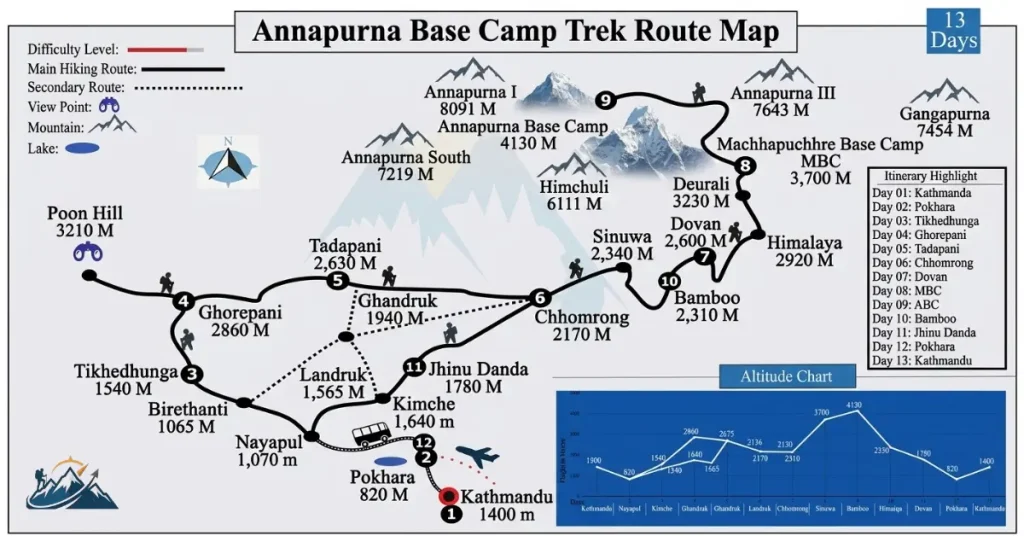
The Annapurna Base Camp trek duration typically runs 7 to 9 days on the trail, covering roughly 70 to 115 km round trip. The exact distance depends heavily on your route: a direct approach starting from Jhinu Danda or Kimche and skipping the Poon Hill loop can run closer to 70-80 km, while the classic itinerary via Nayapul and Poon Hill, with its extra ridge climb and longer approach, stretches to 90-115 km. Most standard itineraries follow a pattern like this:
- Drive from Pokhara to Nayapul/Kimche, trek to Tikhedhunga or Ulleri
- Ulleri to Ghorepani or directly toward Chhomrong (route-dependent)
- Chhomrong to Bamboo or Sinuwa
- Bamboo to Deurali, via Himalaya and Dovan
- Deurali to Annapurna Base Camp, via Machapuchare Base Camp (MBC)
- Annapurna Base Camp backs down to Bamboo or Sinuwa
- Descent to Jhinu Danda (hot springs) or Ghandruk 8-9. Return trek and drive back to Pokhara
Adding Poon Hill for sunrise views over the Annapurna and Dhaulagiri ranges extends the trek by roughly one to two days and adds one more steep climb early in the itinerary. For a stop-by-stop breakdown of route variants, distances, and daily stages, see our Annapurna Base Camp trek map guide.
What Makes the Annapurna Base Camp Trek Difficult
1. Stone Steps and Terrain
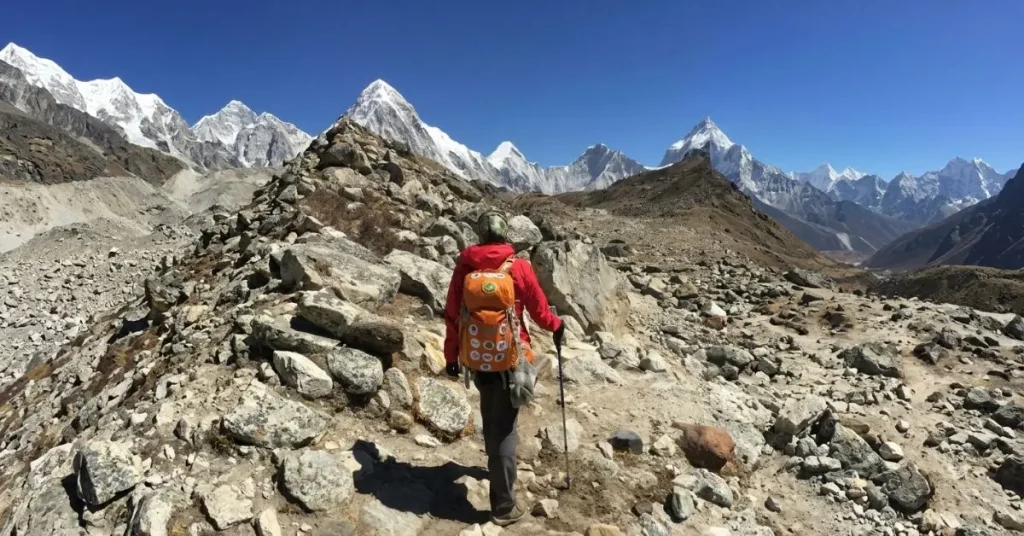
Ask trekkers who have done both, and many will say the stone staircases hurt more than the altitude. The stretch through the Modi Khola gorge, particularly between Chhomrong and Bamboo, and again on the final push and return through that same section, involves thousands of uneven stone steps, both up and down. This is where knee strain and fatigue tend to build, especially on the descent.
2. Consecutive Trekking Days
ABC doesn’t have a single brutal day so much as a demanding stretch of 6-9 days with limited full rest. Even with an acclimatization day built in, trekkers are walking most days, which rewards steady pacing over speed.
3. Altitude Above 3,000 Meters
From Deurali upward, thinner air makes each step feel more effortful, sleep can be lighter, and appetite often drops. None of this is dangerous when managed with proper pacing, hydration, and awareness of AMS symptoms, but it’s a real part of why the trek feels harder in its final stages.
4. Weather Variability
Sudden afternoon cloud, rain, or, outside peak season, snow near Annapurna Base Camp can make trails slippery and reduce visibility with little warning, adding an unpredictable layer to daily difficulty.
Annapurna Base Camp Trek Difficulty for Beginners
Yes, the Annapurna Base Camp trek is realistic for beginners. It is one of the reasons ABC is recommended so often as a first Himalayan trek. Unlike routes crossing a high mountain pass, ABC has no technical sections, no glacier crossings, and teahouse accommodation the entire way, meaning no camping gear or wilderness survival skills are needed.
So how difficult is the Annapurna Base Camp trek for beginners specifically? In practice, most first-timers find the trail itself approachable; what catches people off guard is the cumulative effect of walking several days in a row on stone steps. That’s the core of Annapurna Base Camp trek difficulty for beginners: manageable terrain and no technical demands, but real preparation still matters. First-time trekkers who do best on ABC typically:
- Have a baseline of regular cardio activity (walking, hiking, cycling, or similar) in the weeks before departure
- Build in a few practice hikes with a loaded daypack before arriving in Nepal
- Choose an itinerary with the standard acclimatization day rather than a compressed schedule
- Go in with realistic expectations about 5-7 hour walking days on consecutive days
| Quick Tip: If this is your first multi-day trek, adding one extra buffer day to your itinerary, even an unplanned rest day in Chhomrong or Bamboo, gives your body more room to acclimatize and your legs more room to recover from the stone steps. |
How Fit Do You Need to Be for the Annapurna Base Camp Trek?
You don’t need athletic-level fitness, but a reasonable baseline of cardiovascular endurance and leg strength makes a noticeable difference in how the trek feels day to day. Someone who can comfortably walk 5-6 hours with a daypack on hilly terrain, on consecutive days, is generally well prepared for ABC.
Useful preparation in the two to three months before the trek includes:
- Regular walking, hiking, or stair-climbing sessions to build leg endurance
- Cardio work such as jogging, cycling, or swimming for overall stamina
- Practice hikes carrying the daypack weight you’ll actually trek with
- Basic strength work for knees and ankles, which takes the most strain on descents
Is Annapurna Base Camp Harder or Easier Than Everest Base Camp?
This is one of the most common comparisons trekkers make when choosing between Nepal’s two most popular base camp treks, and it’s often where the question “how hard is the Annapurna Base Camp trek” really gets put in perspective. ABC and EBC are both non-technical teahouse treks, but they differ in altitude, duration, and access.
| Factor | Annapurna Base Camp | Everest Base Camp |
|---|---|---|
| Max altitude | 4,130 m | 5,364 m |
| Typical duration | 7-9 days | 12-14 days |
| Access | Drive from Pokhara | Mountain flight to Lukla |
| Altitude exposure | Shorter time above 3,000 m | Longer time above 3,000 m |
| Terrain challenge | Steep stone steps, valley terrain | Longer high-altitude exposure, rockier trail |
| Overall difficulty | Moderate | Moderate to moderately strenuous |
In short, Annapurna Base Camp is generally considered the less demanding of the two, mainly because of its lower maximum altitude and shorter overall duration. Everest Base Camp involves more time at altitude and a longer trip overall, which raises both the physical and logistical difficulty. Neither trek requires technical climbing skills.
Does Weather Make the Annapurna Base Camp Trek More Difficult?
Yes, season has a direct effect on how difficult the trail feels.
- Spring (March-May) and autumn (September-November) offer the most stable conditions and are generally considered the easiest times to trek.
- Monsoon season (June-August) brings slippery stone steps, leeches at lower elevations, and limited mountain views.
- Winter (December-February) can bring snow and colder conditions near Annapurna Base Camp itself, which adds difficulty even though trails are quieter.
How to Prepare for the Annapurna Base Camp Trek
Annapurna Base Camp trek preparation doesn’t need to be complicated, but a little structure goes a long way toward making the difficulty feel manageable rather than overwhelming. Here’s how to prepare for the Annapurna Base Camp trek step by step:
- Build cardio and leg endurance in advance. Aim for regular hiking, walking, or stair training in the 8-12 weeks before your trip, gradually increasing distance and elevation gain.
- Break in your boots and test your gear. Blisters and poorly fitted boots cause more trek-ending problems than altitude does. Test your full kit, including layers and your daypack, on a practice hike.
- Plan an itinerary with a built-in acclimatization day. Don’t compress the schedule purely to save time or money. The standard pacing exists for a physiological reason.
- Arrange your guide and permits in advance. A licensed guide is currently required for the Annapurna Conservation Area, and permit rules are updated periodically. For current permit and cost details, see our Annapurna Base Camp trek cost guide.
- Learn the basic signs of AMS before you go. Headache, nausea, dizziness, and loss of appetite above 3,000 m are signals to slow down, not push through.
| Important: Never ascend to a higher sleeping altitude while showing symptoms of acute mountain sickness. Descending is always the correct first response if symptoms worsen. This is a core principle used by mountain medicine organizations across the Himalaya. |
Common Mistakes That Make ABC Feel Harder Than It Is
- Skipping practice hikes and arriving with no recent walking fitness
- Rushing the itinerary by cutting the acclimatization day to save one night’s lodging cost
- Underpacking layers for the temperature swing between Pokhara and Annapurna Base Camp
- Ignoring early AMS symptoms instead of resting or descending
- Overpacking the daypack, which adds unnecessary strain on the stone-step sections
Responsible and Safe Trekking in the Annapurna Region
The Annapurna Base Camp trail runs through the Annapurna Conservation Area, Nepal’s first and largest protected area, managed by the National Trust for Nature Conservation (NTNC). Trekking responsibly here means carrying out all non-biodegradable waste, using refill or boiled water instead of buying bottled water at teahouses, staying on marked trails to protect fragile alpine vegetation near the Sanctuary, and respecting local customs in Gurung and Magar villages along the route.
Trekking safely means treating altitude with the same seriousness regardless of how fit you are. AMS affects experienced hikers and beginners alike, and it is not predictable from fitness level. No trek is entirely risk-free, and travelers should always carry appropriate insurance and be prepared to adjust plans based on how their body responds.
Final Thoughts
Annapurna Base Camp earns its reputation as a moderate, achievable Himalayan trek. It is hard enough to demand real preparation and approachable enough that first-time trekkers complete it every season.
The difficulty comes less from any single dramatic obstacle and more from the combination of stone-stepped terrain, several consecutive walking days, and altitude gain above 3,000 meters.
Trekkers who prepare their fitness, respect the acclimatization schedule, and pack for changeable mountain weather generally find the trek challenging in a rewarding way rather than an overwhelming one.
If you’re planning a trip to Nepal beyond ABC, feel free to explore the rest of our Nepal travel blog for more trekking guides, destination breakdowns, and practical planning tips.
Annapurna Base Camp Trek Difficulty FAQs
1. How difficult is the Annapurna Base Camp trek?
The Annapurna Base Camp trek is moderately difficult. It requires several consecutive days of 5 to 7 hour walks and reaches 4,130 m but involves no technical climbing or glacier travel.
2. Is the Annapurna Base Camp trek easy for beginners?
The Annapurna Base Camp trek is manageable for beginners who prepare with basic cardio training and realistic expectations, making it one of the more accessible high-altitude treks in Nepal.
3. Can a beginner do the ABC trek?
A beginner can do the ABC trek successfully in most cases, especially with a few months of walking or hiking preparation and an itinerary that includes the standard acclimatization day.
4. Is ABC tougher than EBC?
ABC is generally considered less tough than EBC, mainly because it reaches a lower maximum altitude (4,130 m vs. 5,364 m) and takes fewer days on the trail.
5. Is Annapurna harder than Everest Base Camp?
Annapurna Base Camp is typically easier than Everest Base Camp overall, due to shorter duration, lower altitude, and less cumulative time spent above 3,000 meters.
6. Is the Annapurna Base Camp trek risky?
The Annapurna Base Camp trek carries the same general risks as any high-altitude trek, primarily altitude sickness, changeable mountain weather, and uneven terrain, all of which are manageable with proper pacing and preparation.
7. How fit do you need to be for the Annapurna Base Camp trek?
You need a moderate fitness baseline for the Annapurna Base Camp trek. The ability to walk 5 to 6 hours on hilly terrain with a daypack on consecutive days is a realistic benchmark.
8. What makes the Annapurna Base Camp trek difficult?
The Annapurna Base Camp trek is difficult mainly due to its steep stone-stepped terrain, several consecutive trekking days, and altitude gain above 3,000 meters in the final stages.
9. Does altitude make the Annapurna Base Camp trek difficult?
Altitude does add difficulty above roughly 3,000 meters, where thinner air can affect breathing, sleep, and energy levels, though the maximum elevation of 4,130 m is moderate compared to other Himalayan treks.
10. Do you need technical climbing skills for the ABC trek?
No technical climbing skills are needed for the ABC trek. It is a teahouse trek on maintained trails with no ropes, crampons, or glacier travel involved.
11. How can I prepare for the Annapurna Base Camp trek?
You can prepare for the Annapurna Base Camp trek by building cardio and leg endurance beforehand, breaking in your boots, choosing an itinerary with a rest day, and learning the basic warning signs of altitude sickness.
12. Does weather make the Annapurna Base Camp trek more difficult?
Weather does affect trek difficulty significantly. Monsoon rain and winter snow both make trails more challenging, while spring and autumn generally offer the most stable, manageable conditions.
Sources
- National Trust for Nature Conservation (NTNC): Annapurna Conservation Area Project overview: https://ntnc.org.np/project/annapurna-conservation-area-project-acap
- Himalayan Rescue Association Nepal: Altitude illness prevention guidance: https://www.himalayanrescue.org/health-problems
Sandeep Poudel is the founder of Wander Himalayan and a lifelong traveler with a deep interest in Nepal’s mountains, culture, landscapes, and local communities. His interest in exploring Nepal began early in life and has grown into a passion for discovering places beyond the usual tourist routes and understanding what makes each destination unique.
From detailed trekking guides and packing advice to destination guides, travel costs, transportation, and local insights, Sandeep focuses on information that travelers can actually use when planning a trip.