
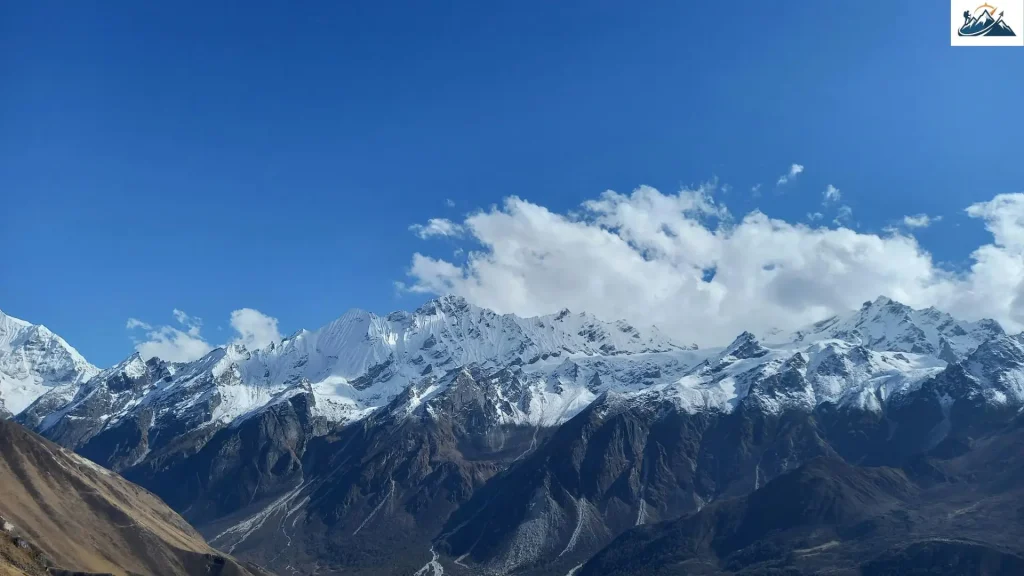
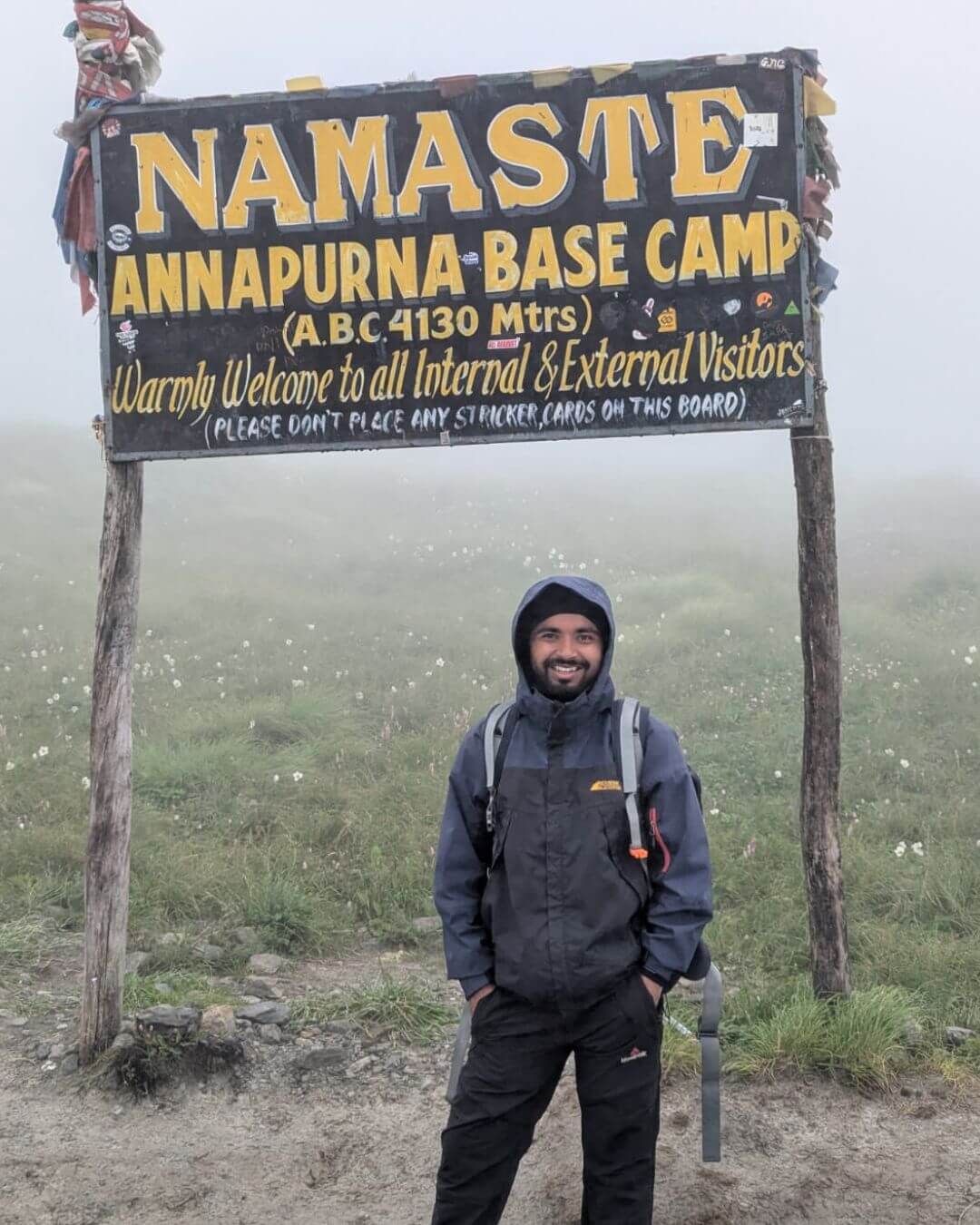
Langtang Valley is a glacier-carved valley in central Nepal, roughly 7-8 hours by road from Kathmandu, known for close-up views of Langtang Lirung (7,234 m), Tamang villages, and one of the shortest classic treks in the Himalayas. This guide covers everything you need to plan a visit: what there is to see, when to go, how to get there, permits and costs, difficulty, itineraries, and safety.
The valley is often called the “Valley of Glaciers” because it’s flanked by more than a dozen glaciers descending from peaks like Langtang Lirung (7,234m) and Langtang Ri.
Langtang Valley is a glacier-carved Himalayan valley in Rasuwa district, about 60 km north of Kathmandu, reachable by a 7-8 hour drive to Syabrubesi followed by a 5-7 day trek. Highlights include Kyanjin Gompa, Kyanjin Ri, Tserko Ri, and Tamang culture. Best visited March-May or September-November. Foreign trekkers need a Langtang National Park permit, a TIMS card, and a licensed guide.
Table of Contents
Key Takeaways
- Langtang Valley sits inside Langtang National Park in Rasuwa district, within Nepal’s Bagmati Province, roughly 60 km north of Kathmandu as the crow flies.
- The standard Langtang Valley trek takes 5-7 trekking days round-trip from Syabrubesi, making it one of the most accessible multi-day Himalayan treks from Kathmandu.
- The highest points reached on the standard route are Kyanjin Ri (4,773 m) and Tserko Ri (about 5,000 m), both day hikes from Kyanjin Gompa.
- The valley is home to Tamang communities, whose Tibetan-influenced Buddhist culture, monasteries, and cheese-making traditions shape the trekking experience.
- Best seasons are spring (March-May) for rhododendron blooms and autumn (September-November) for the clearest mountain views.
- Foreign trekkers must carry a Langtang National Park entry permit and a TIMS card and, since April 2023, must trek with a licensed guide.
- Langtang Village was destroyed by an earthquake-triggered avalanche in April 2015; it has since been rebuilt on safer ground, and the trail is fully open again.
- Langtang can be combined with the sacred lake of Gosainkunda or the Tamang Heritage Trail for a longer itinerary.
What Is Langtang Valley?
Langtang Valley is a high glacial valley in Nepal’s Rasuwa district, enclosed by the Langtang Himal range on one side and the Tibetan border on the other. It lies inside Langtang National Park, Nepal’s first Himalayan national park, established in 1976.
The valley is often called the “Valley of Glaciers” because it’s flanked by more than a dozen glaciers descending from peaks like Langtang Lirung (7,227m) and Langtang Ri. Unlike Everest or Annapurna, Langtang is reached almost entirely by road and foot from Kathmandu, without a domestic flight, which is a major part of its appeal.
| Quick Fact: Langtang National Park covers 1,710 square kilometers and shares its northern boundary with the Tibet Autonomous Region of China. |
Where Is Langtang Valley Located?
Langtang Valley lies in Rasuwa district, Bagmati Province, in north-central Nepal, roughly 60 km north of Kathmandu in a straight line, though the road distance to the trailhead at Syabrubesi is closer to 120-140 km because of the mountainous terrain.
The valley runs east-west, starting at the roadhead of Syabrubesi (about 1,550 m) and climbing through forest and pasture to Kyanjin Gompa (about 3,870 m), near the base of Langtang Lirung. To the north, the valley borders Tibet; to the south, it connects toward the Gosainkunda lakes and the Helambu region.
| Local Insight: Langtang is often called “the trek in Kathmandu’s backyard” because it’s the closest major Himalayan trekking region to the capital that doesn’t require a flight. |
Why Visit Langtang Valley?
Langtang Valley is worth visiting because it delivers a full high-altitude Himalayan experience, including glaciers, 7,000m peaks, alpine lakes, and Tamang mountain culture, in about half the time of longer treks like Everest Base Camp or the Annapurna Circuit.
Compared with Nepal’s more crowded routes, Langtang sees a fraction of the foot traffic, so trails and teahouses feel quieter, even in peak season. The valley’s Tamang villages also offer a cultural layer that is distinct from the Sherpa culture of the Everest region, visible in local dress, Buddhist monasteries, and the valley’s well-known yak cheese, produced at a cheese factory near Kyanjin Gompa that dates back to the 1950s.
| Pro Tip: If your trip to Nepal is under two weeks, Langtang is one of the few routes where you can realistically complete a full teahouse trek to a 5,000m viewpoint and still have days left for Kathmandu or Pokhara. |
Explore More of Nepal: Langtang Valley is just one of many incredible places to explore in Nepal. Discover more destinations and find the right places for your trip.
Places to Visit in Langtang Valley
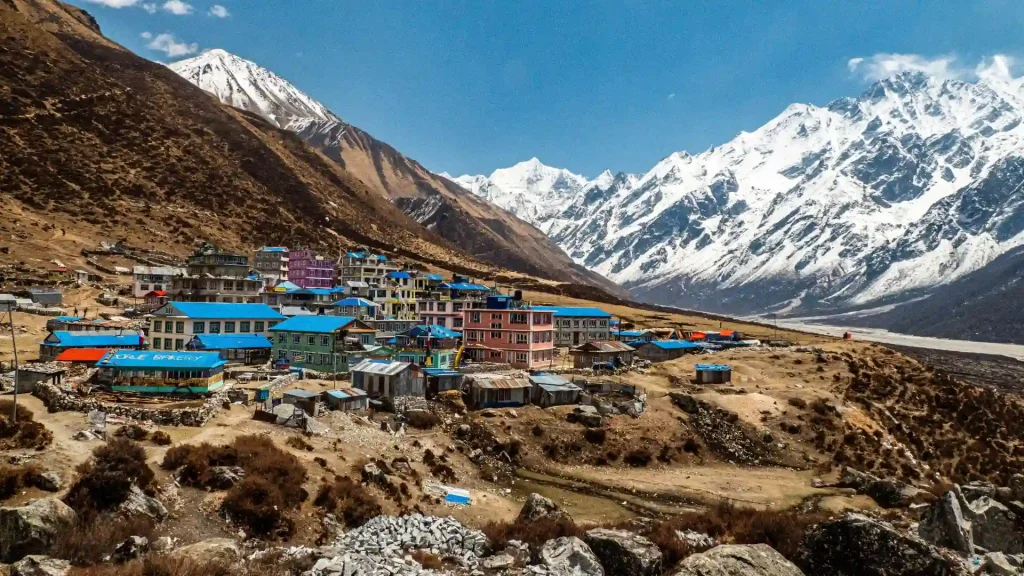
The best places to visit in Langtang Valley are strung along the main trekking trail between Syabrubesi and Kyanjin Gompa, with a few worthwhile side trips.
| Place | Elevation | Why Visit |
| Syabrubesi | ~1,550 m | Trailhead village at the confluence of the Bhote Koshi and Langtang rivers |
| Lama Hotel | ~2,470 m | Forest lodge stop known for langur monkey sightings |
| Langtang Village | ~3,430 m | Rebuilt Tamang village and site of the 2015 earthquake memorial |
| Kyanjin Gompa | ~3,870 m | Trek’s main hub: monastery, cheese factory, and viewpoint access |
| Kyanjin Ri | 4,773 m | Closer, steeper viewpoint above Kyanjin Gompa |
| Tserko Ri | ~5,000 m | The trek’s highest point, with panoramic Langtang Himal views |
| Gosainkunda Lake | ~4,380 m | Sacred alpine lake, reachable via a demanding side route |
1. Kyanjin Gompa
Kyanjin Gompa is the cultural and logistical heart of the upper valley, sitting at about 3,870m beneath Langtang Lirung. It’s home to a centuries-old Buddhist monastery of the Nyingma school and a cheese factory that still processes yak milk using techniques introduced by a Swiss dairy development project in the 1950s. Most itineraries spend one or two nights here, using it as a base for the side hikes to Kyanjin Ri and Tserko Ri.
2. Kyanjin Ri and Tserko Ri
These two viewpoints are the highlight day hikes of the trek. Kyanjin Ri, at 4,773m, is a steep but shorter climb of roughly 4-5 hours round-trip, suitable for most trekkers who are handling the altitude reasonably well. Tserko Ri, at close to 5,000 m, is a longer and more demanding 7-9 hour round-trip that requires solid acclimatization; the payoff is a wider 360-degree panorama that, on a clear day, extends toward Shishapangma across the Tibetan border.
| Trekker’s Tip: Do Kyanjin Ri first if you are spending two nights at Kyanjin Gompa. It doubles as an acclimatization hike and gives you a read on how your body is handling the altitude before attempting Tserko Ri. |
3. Langtang Village and the Earthquake Memorial
Langtang Village, at roughly 3,430m, was buried by a massive earthquake-triggered avalanche on 25 April 2015, when a magnitude-7.8 earthquake centered in Gorkha shook loose ice and rock from Langtang Lirung. The disaster killed around 300 people in the village and surrounding area, including many local Tamang residents and visiting trekkers.
Very few people in the village itself survived; most who lived escaped only because they happened to be elsewhere that morning. The community has since rebuilt the village on more stable ground nearby, and the trail passes a memorial near the original site. Trekking through Langtang today also supports a community that depends heavily on tourism income to recover economically.
| Important: The subject of the earthquake is still sensitive locally. Ask your guide before taking photographs near the memorial site, and be mindful that some residents lost family members here. |
4. Gosainkunda Lake
Gosainkunda is a sacred alpine lake at about 4,380m, considered holy by both Hindus and Buddhists and linked in Hindu mythology to the god Shiva. It’s not on the standard Langtang Valley out-and-back route but is commonly added as an extension or combined into a longer Langtang-Gosainkunda-Helambu circuit. Thousands of pilgrims visit during the Janai Purnima festival in August.
5. Syabrubesi
Syabrubesi is the trailhead village, sitting at about 1,550 m right where the Bhote Koshi and Langtang rivers meet. Since the trek is entirely road-and-foot access with no flight involved, this is where the drive from Kathmandu ends and the walking begins. It’s a low-key Tamang village with basic teahouses, and most trekkers spend their first night here. The low altitude means zero risk of AMS, so it’s a comfortable place to recover from the long drive before starting the climb.
6. Lama Hotel
Lama Hotel, at roughly 2,470m, is a small cluster of lodges in dense forest along the Langtang Khola. There isn’t much to “see” here beyond the setting itself, but it’s a well-loved stop because the surrounding rhododendron and oak forest is one of the best places on the trek to spot grey langur monkeys and sometimes red pandas with luck. It’s typically the second night’s stop, breaking up the climb between Syabrubesi and the higher villages.
Things to Do in Langtang Valley
Beyond the main trekking trail, there’s a range of activities to fill out a Langtang itinerary.
- Day hikes from Kyanjin Gompa, including Kyanjin Ri, Tserko Ri, or the shorter walk up to the Langtang Glacier viewpoint
- Yala Peak climb (5,520 m), a non-technical trekking peak suitable for fit trekkers with some scrambling experience.
- Visit the Kyanjin cheese factory to see traditional yak-cheese production and buy cheese to take home
- Explore Tamang monasteries, including the gompa at Kyanjin and smaller shrines along the trail
- Birdwatching and wildlife spotting. The lower forest sections are good for langur monkeys and, with luck, red pandas
- Extend to Gosainkunda or the Tamang Heritage Trail for a longer, more varied circuit
| Photography Tip: The clearest light on Langtang Lirung is usually in the early morning before clouds build up the valley from the south. Plan summit hikes to Kyanjin Ri or Tserko Ri with a pre-dawn start. |
Langtang Valley Trek: Difficulty
The Langtang Valley trek is graded moderate, making it a reasonable choice for fit first-time trekkers, though the side hikes to Kyanjin Ri and Tserko Ri raise the difficulty considerably.
The main trail follows a single valley with a steady, well-defined gradient rather than the repeated steep ascents and descents found on routes like the Everest Base Camp trek. Daily walking is typically 5 to 7 hours. The main challenges are altitude, as the trek climbs from about 1,550m to nearly 3,870m in four days, and the optional push to Tserko Ri near 5,000m, which is genuinely strenuous and altitude-sensitive.
| Safety Advice: Acute Mountain Sickness (AMS) is the primary risk on this trek, not technical terrain. Build in at least one acclimatization day at Kyanjin Gompa, drink 3-4 liters of water daily, and descend immediately if you develop a worsening headache, nausea, or loss of coordination. |
Best Time to Visit Langtang Valley
The best time to visit Langtang Valley is during spring (March to May) or autumn (September to November), when skies are clearest and trails are driest.
| Season | Months | Conditions |
| Spring | March-May | Rhododendron forests in bloom, warm days, cool nights, good visibility |
| Summer/Monsoon | June-August | Heavy rain, leeches at lower elevation, and landslide risk on the access road |
| Autumn | September-November | Peak season, clearest mountain views, stable weather |
| Winter | December-February | Cold, possible snow above Kyanjin Gompa, fewer crowds, some lodges closed |
| Weather Tip: Autumn (October-November) gives the most reliable mountain visibility, but expect the busiest teahouses. Spring trades a little clarity for rhododendron blooms and thinner crowds on the trail itself. |
How to Get to Langtang Valley
Langtang Valley is reached from Kathmandu by road to Syabrubesi, followed by a multi-day trek on foot; there is no airstrip or flight option into the valley.
- Kathmandu to Syabrubesi: A local bus or private jeep covers the roughly 120-140 km route in about 7-8 hours, climbing over the Kathmandu-Trishuli-Dhunche road. Jeeps are faster and more comfortable than the public bus, especially on the rougher final stretch.
- Syabrubesi to Lama Hotel: The trek begins here, following the Langtang Khola upstream through forest, typically a 6-7 hour walking day.
- Onward to Kyanjin Gompa: Two to three further trekking days bring you via Langtang Village to Kyanjin Gompa, the trek’s main destination.
| Local Insight: Book your Kathmandu-Syabrubesi jeep or bus the day before if possible; seats fill quickly in peak season, and the last direct departures from Kathmandu’s Machha Pokhari/Balkhu bus stations tend to leave early in the morning. |
Permits Required for Langtang Valley Trek
Two documents are mandatory for the Langtang Valley trek: the Langtang National Park entry permit and a TIMS (Trekkers’ Information Management System) card, and since April 2023, all foreign trekkers must also be accompanied by a licensed guide.
| Permit | Foreign Nationals | SAARC Nationals | Nepali Citizens |
| Langtang National Park Entry Permit | NPR 3,000 (~USD 22-25) | NPR 1,500 | NPR 100 |
| TIMS Card | NPR 2,000 (~USD 15) | NPR 1,000 | Not required |
Both permits can be arranged through a registered trekking agency in Kathmandu or, in some cases, at the entry checkpoint in Dhunche. Since the Nepal Tourism Board’s April 2023 policy change, independent (“Free Independent Trekker”) permits are no longer issued to foreign nationals, and all foreign trekkers, solo or in a group, must trek with a licensed guide affiliated with a government-registered agency.
| Permit Update: The mandatory-guide rule applies to all national parks and conservation areas in Nepal, including Langtang. Budget for a guide’s daily rate when planning costs. It is no longer optional for foreign passport holders. |
Langtang Valley Trek Cost
A standard teahouse-based Langtang Valley trek typically costs USD 500-900 per person for a 7-8 day package that includes permits, a licensed guide, accommodation, meals, and Kathmandu-Syabrubesi transport.
| Budget Tip: Costs rise noticeably with side trips like Tserko Ri or Gosainkunda (extra trekking days) and with private jeep transport instead of shared transport. Traveling in a small group rather than solo also reduces the per-person guide cost, since the daily guide fee is often shared. |
Rough daily costs on the trail itself:
- Teahouse accommodation: USD 3-10 per night (often discounted or free with meals purchased)
- Meals: USD 20-30 per day (prices rise with altitude)
- Wi-Fi and charging: USD 2-5 per use at higher villages
- Hot shower: USD 2-4
Langtang Valley Itinerary (7 Days)
This is a standard, achievable itinerary for most reasonably fit trekkers, including one acclimatization day.
| Day | Route | Approx. Elevation |
| 1 | Kathmandu to Syabrubesi (drive) | 1,550m |
| 2 | Syabrubesi to Lama Hotel | 2,470m |
| 3 | Lama Hotel to Langtang Village | 3,430m |
| 4 | Langtang Village to Kyanjin Gompa | 3,870m |
| 5 | Acclimatization day: hike Kyanjin Ri (or Tserko Ri) | 4,773m (day hike) |
| 6 | Kyanjin Gompa to Lama Hotel (descend) | 2,470m |
| 7 | Lama Hotel to Syabrubesi, drive to Kathmandu | 1,550m |
For trekkers with more time, adding two to three days allows a Tserko Ri summit attempt, an extension to Gosainkunda, or a loop out through the Tamang Heritage Trail instead of retracing the same trail back to Syabrubesi.
What to Pack for Langtang Valley
Layering is essential on this trek, since daytime temperatures at lower elevations can feel warm while nights at Kyanjin Gompa regularly drop below freezing, even in the main spring and autumn seasons.
| Packing Tip: Temperatures at Kyanjin Gompa frequently fall below 0°C (32°F) after sunset from October through April, so an insulated down jacket rated to at least -10°C and a good sleeping bag liner are worth the extra pack weight, even in “shoulder” trekking months. |
- Insulated down jacket
- Thermal base layers (top and bottom)
- Waterproof, breathable outer shell
- Trekking boots, broken in before the trip
- Sleeping bag (rated to at least -10°C for higher nights)
- Sun hat, sunglasses, and high-SPF sunscreen (UV is intense at altitude)
- Headlamp with spare batteries (essential for pre-dawn viewpoint hikes)
- Water purification tablets or a filter
- Basic first-aid kit, including altitude medication if prescribed by a doctor
- Power bank (charging costs extra at teahouses and can be unreliable)
Accommodation and Food in Langtang Valley
Accommodation on the Langtang trail is almost entirely teahouse-style: simple family-run lodges with twin rooms, shared bathrooms (attached bathrooms are rare above Lama Hotel), and a communal dining room heated by a central stove in the evening.
Meals are built around dal bhat (lentils, rice, and vegetable curry), along with soups, noodles, momo (dumplings), and, near Kyanjin Gompa, locally made yak cheese. Menus become shorter, and prices rise the higher you climb, reflecting the cost of porting supplies up the valley.
Culture: The Tamang People of Langtang
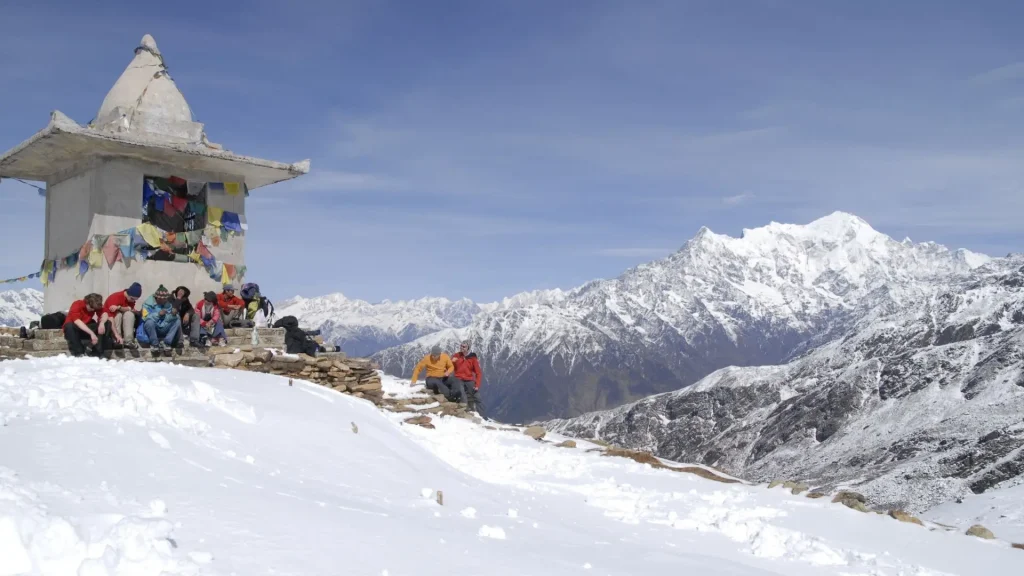
Langtang Valley is home to Tamang communities, one of Nepal’s Tibeto-Burman ethnic groups, whose Buddhist traditions, language, and architecture give the valley its distinct cultural character.
Villages along the trail feature prayer wheels, chortens, and mani walls carved with Buddhist mantras, which trekkers should pass on the left, following local custom. The Tamang Heritage Trail, a separate route branching from Syabrubesi, was developed specifically to showcase Tamang village life, homestays, and hot springs, and pairs well with a Langtang Valley trek for travelers with extra time.
Safety Tips for Langtang Valley Trek
The two main safety considerations on this trek are altitude sickness and seasonal trail conditions, both manageable with standard precautions.
- Ascend gradually and avoid gaining more than 500 m of sleeping altitude per day above 3,000 m
- Take the built-in acclimatization day at Kyanjin Gompa rather than skipping it to save time
- Carry comprehensive travel insurance that explicitly covers high-altitude trekking and helicopter evacuation up to at least 5,000 m
- Avoid trekking alone off the main trail; conditions above Kyanjin Gompa can change quickly
- Check current trail and weather conditions with your guide or agency before departure, particularly in monsoon season when landslides can affect the Syabrubesi access road
| Important: A licensed guide is now a legal requirement for foreign trekkers on this route, and it also provides a practical safety benefit. Guides carry pulse oximeters, monitor for AMS symptoms, and can coordinate emergency evacuation through their agency. |
Common Mistakes to Avoid
- Skipping the acclimatization day to save one day of trekking. This is the single biggest contributor to AMS cases on this route.
- Underestimating Tserko Ri. It is a genuine high-altitude mountain hike, not a casual add-on, and needs a pre-dawn start and good acclimatization.
- Traveling without a licensed guide. This is no longer optional for foreign nationals, and permits will not be issued without one.
- Packing only for daytime temperatures. Nights at Kyanjin Gompa are significantly colder than the pleasant daytime weather suggests.
- Booking transport at the last minute in peak season, risking a delayed start to the trek.
Langtang Valley vs. Other Short Treks in Nepal
| Trek | Duration | Max Altitude | Access from Kathmandu |
| Langtang Valley | 5-7 days | ~5,000 m (Tserko Ri) | Road only, no flight |
| Poon Hill (Annapurna) | 4-5 days | ~3,210 m | Road/short flight to Pokhara |
| Mardi Himal | 5-6 days | ~4,500 m | Road/short flight to Pokhara |
| Everest View Trek | 7-8 days | ~3,880 m (Namche area) | Flight to Lukla required |
Langtang stands out among these as the only major short trek reachable entirely by road, which makes it more resilient to the flight cancellations that regularly affect Lukla-bound Everest region trips.
Final thoughts
Langtang Valley offers one of Nepal’s most efficient routes to a genuine high-Himalayan experience: glacier views, a 7,234m peak at close range, Tamang culture, and a trail that’s road-accessible from Kathmandu without a flight.
Whether you stick to the standard 7-day itinerary to Kyanjin Gompa or extend toward Gosainkunda or the Tamang Heritage Trail, Langtang Valley rewards careful acclimatization and a licensed guide with some of the Himalayas’ best value-for-time trekking. If you’re weighing it against other short treks, comparing permits, costs, and seasonality here should give you what you need to plan with confidence.
Plan Your Nepal Adventure: Ready to explore beyond Langtang Valley? Explore Wander Himalayan for more Nepal travel guides, trekking routes, destinations, and practical travel tips.
Frequently Asked Questions
1. Is Langtang Valley worth visiting?
Langtang Valley is worth visiting for travelers who want a genuine high-altitude Himalayan trek, including glaciers, 7,000m peaks, and Tamang culture, without committing two or more weeks or booking a domestic flight. It is quieter than the Everest or Annapurna routes and reachable entirely by road from Kathmandu.
2. How many days do you need for Langtang Valley?
Langtang Valley typically requires 5 to 7 trekking days for the standard out-and-back route to Kyanjin Gompa and back to Syabrubesi, plus two travel days from and to Kathmandu, for a total trip length of about 7 to 9 days.
3. How difficult is the Langtang Valley trek?
The Langtang Valley trek is rated moderate for the main route to Kyanjin Gompa, with steady but manageable daily walking. Difficulty increases significantly for the optional side hikes to Kyanjin Ri (4,773m) and especially Tserko Ri (near 5,000m), both of which demand good acclimatization.
4. What permits do I need for Langtang Valley?
Langtang Valley requires two permits for foreign trekkers: the Langtang National Park entry permit (NPR 3,000) and a TIMS card (NPR 2,000), plus a licensed guide, which has been mandatory for all foreign trekkers in Nepal’s national parks since April 2023.
5. When is the best time to visit Langtang Valley?
The best time to visit Langtang Valley is spring (March-May) for rhododendron blooms and moderate crowds, or autumn (September-November) for the clearest, most stable mountain views. Both seasons avoid the monsoon rains and winter snow that affect the region outside these windows.
6. Can beginners do the Langtang Valley trek?
Beginners with reasonable fitness can complete the standard Langtang Valley trek to Kyanjin Gompa, since the trail follows a single valley with a steady gradient rather than repeated steep passes. First-timers should build in the acclimatization day and treat the Tserko Ri side hike as optional rather than mandatory.
7. Is Langtang Valley safe after the 2015 earthquake?
Langtang Valley is safe to visit today. The trail reopened in 2017 after reconstruction, and Langtang Village has been rebuilt on more stable ground with input from geological assessments. Trekking infrastructure, including teahouses and the trail itself, is fully operational.
8. How do I get to Langtang Valley from Kathmandu?
Langtang Valley is reached from Kathmandu by a 7 to 8 hour drive (by local bus or private jeep) to the trailhead town of Syabrubesi, followed by 5 to 7 days of trekking on foot. There is no flight option into the valley itself.
9. Can you see Everest from Langtang Valley?
Everest is not visible from the Langtang Valley trekking route. The trek instead offers close-up views of the Langtang Himal range, including Langtang Lirung (7,234 m), and on clear days, Shishapangma across the Tibetan border from high viewpoints like Tserko Ri.
10. Is Langtang Valley suitable for families?
Langtang Valley can suit families with trekking-fit teenagers or older children, given its moderate grading and teahouse infrastructure, though the altitude gain to Kyanjin Gompa still requires sensible pacing and an extra acclimatization day for younger trekkers.
11. Do I need travel insurance for the Langtang Valley trek?
Travel insurance is strongly recommended and often required by trekking agencies for the Langtang Valley trek. Choose a policy that explicitly covers trekking at altitude and helicopter evacuation up to at least 5,000m to cover the Tserko Ri side hike.
12. What is the highest point of the Langtang Valley trek?
The highest point most trekkers reach on the Langtang Valley trek is Tserko Ri, at approximately 5,000m, via a demanding day hike from Kyanjin Gompa. Trekkers who skip Tserko Ri typically top out at Kyanjin Ri (4,773m) instead.
Sources
- Department of National Parks and Wildlife Conservation, Government of Nepal: https://dnpwc.gov.np/en/conservation-area-detail/16/
- Al Jazeera: https://www.aljazeera.com/news/2025/4/25/nepal-village-ravaged-by-2015-earthquake-now-a-reluctant-tourist-hotspot
- Nepal Tourism Board: https://ntb.gov.np/
- Department of National Parks and Wildlife Conservation: https://dnpwc.gov.np/
- U.S. Embassy in Nepal, Trekking Guide Requirement Alert (2023): https://np.usembassy.gov/alert-new-requirements-for-use-of-trekking-guides-porters-effective-april-1-2023/