
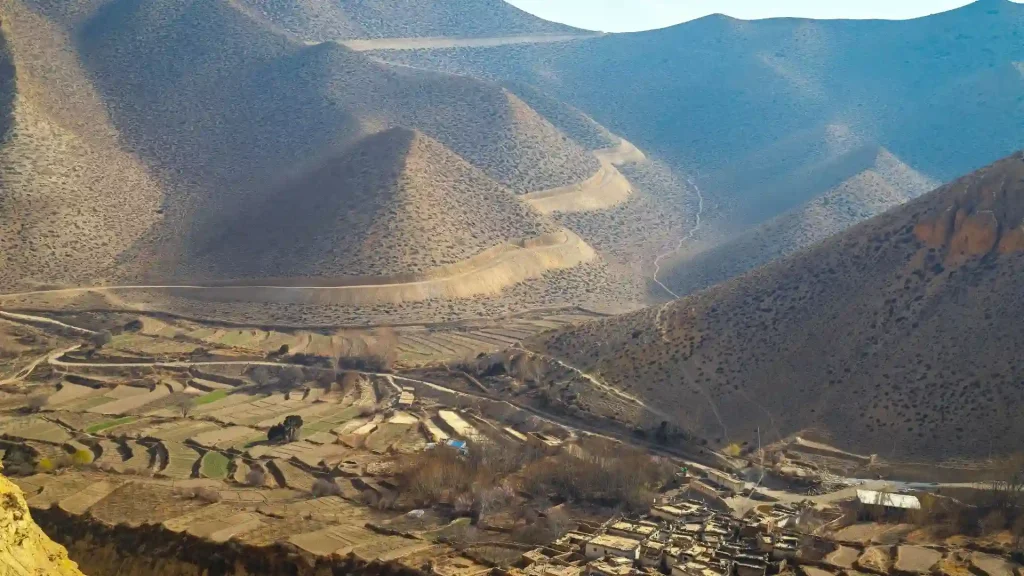
Mustang Nepal is a high-altitude desert region tucked behind the Annapurna and Dhaulagiri massifs, split into two distinct zones: the restricted, Tibetan-influenced Upper Mustang around the walled city of Lo Manthang and the more accessible Lower Mustang around Jomsom and Kagbeni. This Mustang Nepal guide covers everything you need to plan a trip, including where to go, when to go, how to get there, what permits you need, how many days to budget, and what it actually costs.
Wander Himalayan has built this Mustang Nepal guide around the region’s current 2026 permit rules, transport options, and seasonal patterns, so you can plan with confidence rather than piecing together outdated blog posts.
Quick Answer
Mustang is a former Tibetan kingdom in northern Nepal, divided into Upper Mustang (restricted, arid, culturally Tibetan, centered on Lo Manthang) and Lower Mustang (open, greener, centered on Jomsom and Kagbeni). Most trips start with a flight or jeep to Jomsom, then continue by jeep or on foot. Upper Mustang requires a $50-per-day Restricted Area Permit plus a licensed guide; Lower Mustang only needs the standard Annapurna Conservation Area Permit. Best months: March-June and September-November.
Table of Contents
Mustang Nepal: Key Takeaways
- Mustang sits in the rain shadow of the Annapurna and Dhaulagiri ranges, so it’s trekkable even during Nepal’s June-August monsoon, when most other regions are wet and cloudy.
- Upper Mustang (north of Kagbeni) is a restricted area requiring a Restricted Area Permit (RAP) and a licensed guide; Lower Mustang (Jomsom, Marpha, Kagbeni, Muktinath) does not.
- As of late 2025, Nepal replaced the old flat $500 Upper Mustang permit with a $50-per-person, per-day fee; you now pay only for the days you’re inside the restricted zone.
- Since March 2026, solo trekkers can obtain the Upper Mustang restricted-area permit; a two-person minimum is no longer required, though a licensed guide still is.
- Most travelers reach Mustang via a short flight or a full-day jeep ride from Pokhara to Jomsom, then continue north by jeep or on foot.
- Lo Manthang, the walled former capital of the Mustang kingdom, is the region’s cultural centerpiece, with 15th-century monasteries and Tibetan Buddhist art.
- A realistic minimum is 4-5 days for Lower Mustang and Kagbeni; a full Upper Mustang loop to Lo Manthang typically needs 8-12 days on foot, or 4-6 days by jeep.
- The Thakali people, known across Nepal for their distinctive cuisine and trading history, are the dominant ethnic group in Lower Mustang.
What Is Mustang, Nepal?
Mustang is a district in Nepal’s Gandaki Province, occupying the Kali Gandaki River valley between the Annapurna and Dhaulagiri massifs, both over 8,000 meters. Until 2008, Upper Mustang was governed as a semi-autonomous kingdom under its own king, even after Nepal itself became a republic, and its culture, language, and Tibetan Buddhist traditions remained closer to those of the Tibetan plateau than to the rest of Nepal.
The district is commonly split into two very different halves:
- Lower Mustang, the southern, greener portion around Jomsom, Marpha, and Kagbeni, open to all trekkers with a standard permit.
- Upper Mustang, the northern, high-desert portion beyond Kagbeni, centered on Lo Manthang, which remains a restricted area requiring a special permit and guide.
| Quick Fact: Lower Mustang (Jomsom to Kagbeni) was accessible to foreign travelers prior to 1992; Upper Mustang specifically (north of Kagbeni) was completely closed to foreign tourists until March 1992. Upper Mustang has now been open for a little over three decades, which is one reason its monastery murals, fort ruins, and sky caves remain so well preserved compared with more heavily visited parts of Nepal. |
Planning more than just a Mustang? Explore Wander Himalayan for practical Nepal travel guides, destination ideas, trekking information, and tips to help you discover more of Nepal.
Upper Mustang vs. Lower Mustang
The single biggest planning decision for any Mustang trip is how far north you’ll go, since it determines your permits, budget, and guide requirements.
| Feature | Lower Mustang | Upper Mustang |
| Main hub | Jomsom, Kagbeni, Marpha | Lo Manthang |
| Access | Open to all foreign visitors | Restricted Area Permit required |
| Guide required | Recommended, not mandatory | Mandatory |
| Landscape | Greener valley, apple orchards, pine forest near Marpha | Arid high desert, canyons, eroded cliffs |
| Culture | Mixed Thakali and Tibetan-influenced | Strongly Tibetan Buddhist |
| Typical trip length | 3-6 days | 8-12 days on foot, 4-6 by jeep |
| Cost driver | ACAP permit only (~NPR 3,000) | RAP ($50/day) + ACAP + guide fees |
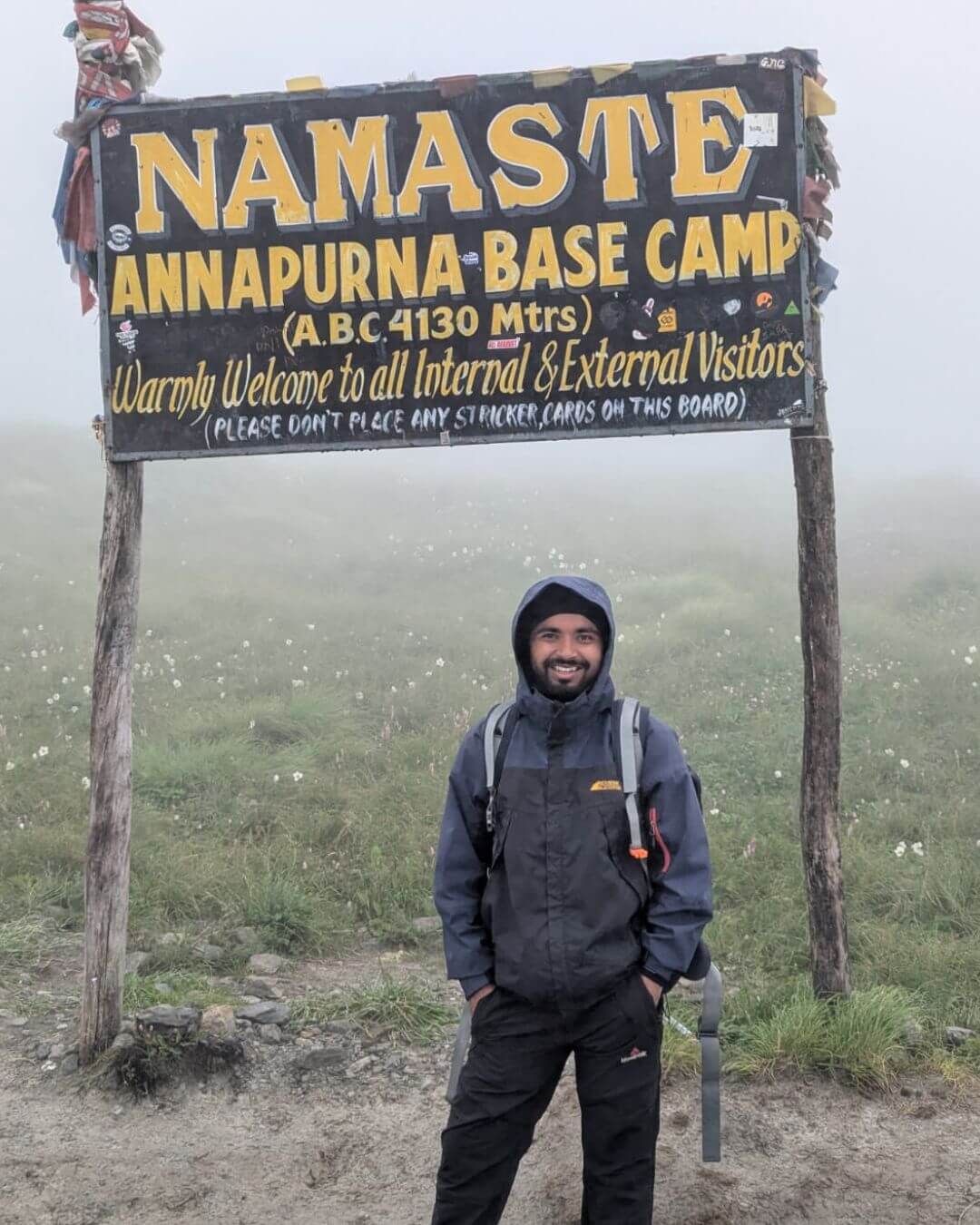
| Local Insight: Many first-time visitors assume “Mustang” automatically means the restricted Upper Mustang trek to Lo Manthang. In practice, a large share of travelers only visit Lower Mustang, including Jomsom, Kagbeni, Marpha, and Muktinath, which is far cheaper, needs no special permit, and can be combined easily with an Annapurna Circuit or Annapurna Base Camp trip. |
Best Time to Visit Mustang
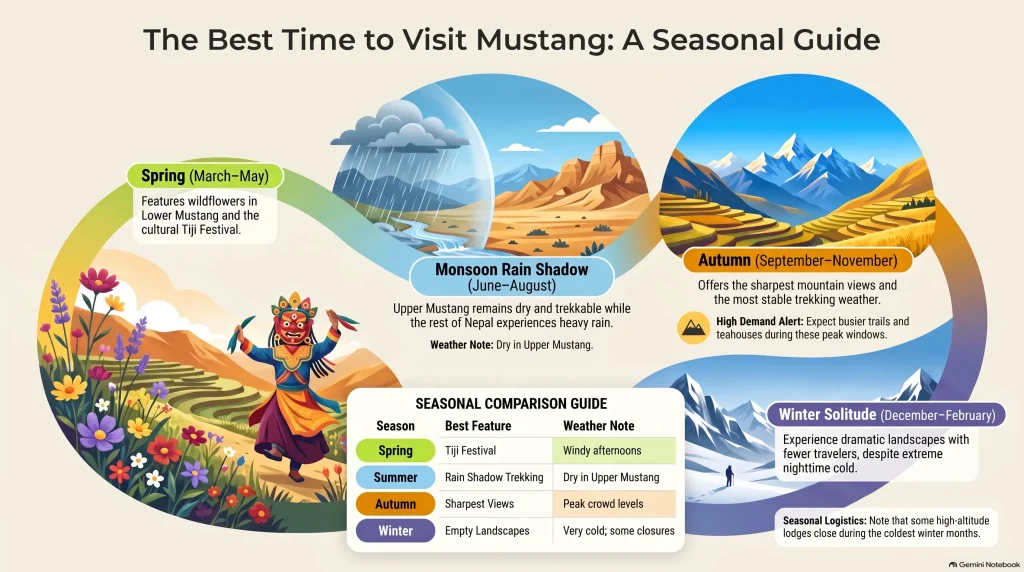
The best time to visit Mustang is March to June (spring) and September to November (autumn), when skies are clear and mountain views are at their sharpest. Unlike most of Nepal, Mustang can also be visited during the monsoon (June-August), because it sits in the rain shadow of the Annapurna and Dhaulagiri ranges and receives comparatively little rainfall.
| Season | Months | Conditions |
| Spring | March-May | Clear mornings, windy afternoons, wildflowers in Lower Mustang, and the Tiji Festival often fall in this window |
| Summer / Monsoon | June-August | Dry and trekkable in Upper Mustang (rain shadow); Lower Mustang and the approach routes get more rain |
| Autumn | September-November | Peak season offers the clearest mountain views and stable weather, but it also means the busiest trails and teahouses. |
| Winter | December-February | Very cold, especially at night; some high-altitude lodges close; fewer travelers, dramatic empty landscapes |
| Weather Tip: Afternoons throughout Mustang, in almost any season, bring strong valley winds funneling up the Kali Gandaki gorge. This is exactly why Jomsom flights are scheduled for early morning only. Plan travel days, especially jeep rides and flights, to start before 9 a.m. |
| Important: The Tiji Festival, a three-day masked-dance ceremony held in Lo Manthang, is one of the biggest draws for Upper Mustang travel and typically falls in May, but the exact dates follow the Tibetan lunar calendar and shift each year. Confirm the current year’s dates with a registered trekking agency before booking flights. |
How to Get to Mustang, Nepal
Getting to Mustang means getting to Jomsom first, the region’s transport hub, and then continuing north by jeep or on foot toward Kagbeni and, if you are headed into the restricted zone, Lo Manthang.
| Route | Method | Duration | Approx. Cost (USD) |
| Kathmandu → Pokhara | Flight | ~25 min | $90-120 |
| Kathmandu → Pokhara | Drive (tourist bus) | 6-8 hrs | $10-25 |
| Pokhara → Jomsom | Flight | ~20 min | $100-190 |
| Pokhara → Jomsom | Local bus | 9-11 hrs | $15-25 |
| Pokhara → Jomsom | Private jeep | ~7-8 hrs | $150-300 (whole vehicle) |
| Jomsom → Kagbeni | Jeep or on foot | 1-3 hrs | Included in jeep hire or free on foot |
| Kagbeni → Lo Manthang | Jeep (restricted area) | 1-2 days with stops | Part of the guided package |
| Kagbeni → Lo Manthang | Trek (restricted area) | 4-5 days | Part of the guided package |
The Pokhara-Jomsom flight is the fastest and most scenic option, threading between the Annapurna and Dhaulagiri massifs above the Kali Gandaki gorge, one of the deepest river gorges in the world when measured against the peaks flanking it. Because afternoon winds regularly force cancellations, flights operate only in the early morning, and travelers heading into Upper Mustang should build at least one buffer day into their schedule in case of weather delays.
The overland route from Pokhara via Beni is now drivable by a 4WD jeep in a single long day outside the monsoon, following the Kali Gandaki past Tatopani, Ghasa, and Marpha. It’s rougher, dustier, and slower than flying, but it’s the only option when flights are grounded, and it lets you see Lower Mustang’s villages along the way.
| Pro Tip: If your schedule allows only one flight leg, fly Pokhara to Jomsom and drive the Kathmandu to Pokhara section instead. The Jomsom flight has the highest chance of weather cancellation, so building in a buffer day on that leg, rather than on the more reliable Kathmandu to Pokhara hop, protects the rest of your itinerary. |
Mustang Permit Requirements
Every foreign visitor needs at least one permit to visit Mustang, and travelers heading into Upper Mustang need three. As of December 2025, Nepal replaced the old flat $500 Upper Mustang permit with a $50-per-person, per-day system, and since March 2026, solo trekkers can obtain the restricted-area permit without needing a second traveler.
| Permit | Required for | Cost (foreign nationals) | Notes |
| Annapurna Conservation Area Permit (ACAP) | All of Mustang (Lower and Upper) | NPR 3,000 (~$23-25) | Issued by NTNC; SAARC nationals pay NPR 1,000 |
| TIMS Card | Independent trekkers in the Annapurna Conservation Area | ~NPR 2,000 (~$15-20) | Increasingly bundled through registered agencies |
| Restricted Area Permit (RAP) — Upper Mustang | North of Kagbeni, toward Lo Manthang | $50 per person, per day | Replaced the old flat $500/10-day fee in late 2025; charged only for days spent inside the restricted zone |
| Permit Update: Two significant Upper Mustang permit rules changed within a few months of each other. On 22 December 2025, the government gazetted the switch from a flat $500 restricted-area fee to $50 per person per day. Then on 22 March 2026, the Department of Immigration dropped the long-standing two-trekker minimum for restricted-area permits nationwide, meaning solo travelers can now be issued an Upper Mustang RAP in their own name, provided they still trek with a licensed guide. |
| Important: Permits for Upper Mustang cannot be obtained independently at a border checkpoint or by walk-in application. The RAP must be arranged in advance through a registered Nepali trekking agency, which submits your documents to the Department of Immigration in Kathmandu or Pokhara. Because of this, independent, agency-free travel is not possible in the restricted zone, even for solo trekkers under the new rules. |
How Many Days Do You Need in Mustang?
How many days you need in Mustang depends entirely on whether you’re staying in Lower Mustang or continuing into the restricted Upper Mustang zone. Budget 3-5 days for a Lower Mustang and Muktinath trip, and 8-12 days if you’re trekking all the way to Lo Manthang, or 4-6 days if you’re covering the same ground by jeep.
| Trip type | Days | Best for |
| Lower Mustang & Muktinath only | 3-5 days | First-time visitors, pilgrims, and travelers combining with Annapurna Circuit |
| Upper Mustang by jeep | 4-6 days | Travelers with limited time who still want Lo Manthang |
| Upper Mustang trek (full loop) | 8-12 days | Trekkers who want the classic walking route with acclimatization built in |
| Mustang + Annapurna Circuit combination | 14-18 days | Travelers wanting both the circuit’s high pass and Mustang’s desert culture |
| Quick Fact: Even the jeep route to Lo Manthang is not a straight drive-through. Most itineraries build in overnight stops at Kagbeni, Chele, Syangboche, and Ghami, both to break up the rough road and to allow gradual acclimatization above 3,000 meters. |
Mustang Nepal Itinerary (Sample, 10 Days)
This sample itinerary covers a classic Upper Mustang trek from Jomsom to Lo Manthang and back via an alternate route.
- Day 1: Fly from Pokhara to Jomsom; acclimatize and explore Jomsom bazaar.
- Day 2: Trek or jeep to Kagbeni; final permit checkpoint.
- Day 3: Kagbeni to Chele.
- Day 4: Chele to Syangboche, crossing Nyi La pass.
- Day 5: Syangboche to Ghami.
- Day 6: Ghami to Charang; visit Charang Monastery.
- Day 7: Charang to Lo Manthang.
- Day 8: Explore Lo Manthang, including royal palace ruins, Thubchen and Jampa monasteries, and a day trip to Chhoser caves.
- Day 9: Lo Manthang to Drakmar or Ghami via alternate return route.
- Day 10: Return to Jomsom via Kagbeni; fly to Pokhara.
| Packing Tip: Because Upper Mustang sits in a high-altitude desert, daytime sun exposure is intense even in cold months. Pack sunscreen, a wide-brimmed hat, and lip balm alongside your usual cold-weather layers. Sunburn is a far more common issue on this trek than on shadier, forested routes like Annapurna Base Camp. |
Places to Visit in Mustang
Mustang’s best places to visit span both halves of the region, from the walled monastery town of Lo Manthang in the restricted north to the orchard villages and pilgrimage sites of Lower Mustang. Here’s where to prioritize your time.
1. Lo Manthang
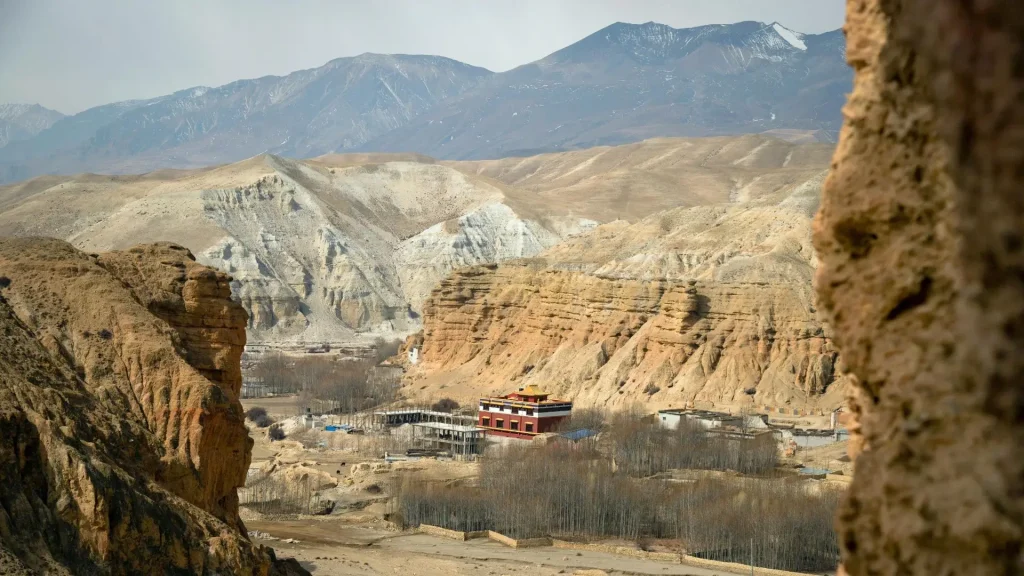
Lo Manthang is the walled former capital of the Mustang kingdom and the primary destination for most Upper Mustang trips. Founded in the 14th century, its narrow lanes are lined with whitewashed homes, and the town holds three major monasteries, Jampa, Thubchen, and Chöde, with mural paintings dating back over 500 years. The ruins of the old royal palace still stand at the town’s center.
2. Kagbeni
Kagbeni marks the official entry point to the Upper Mustang restricted area and is where your permits are checked. It’s a compact, well-preserved medieval village at the confluence of the Kali Gandaki and Jhong rivers, with a working monastery and mud-brick alleyways that make it worth a full day even if you’re not continuing north.
3. Muktinath
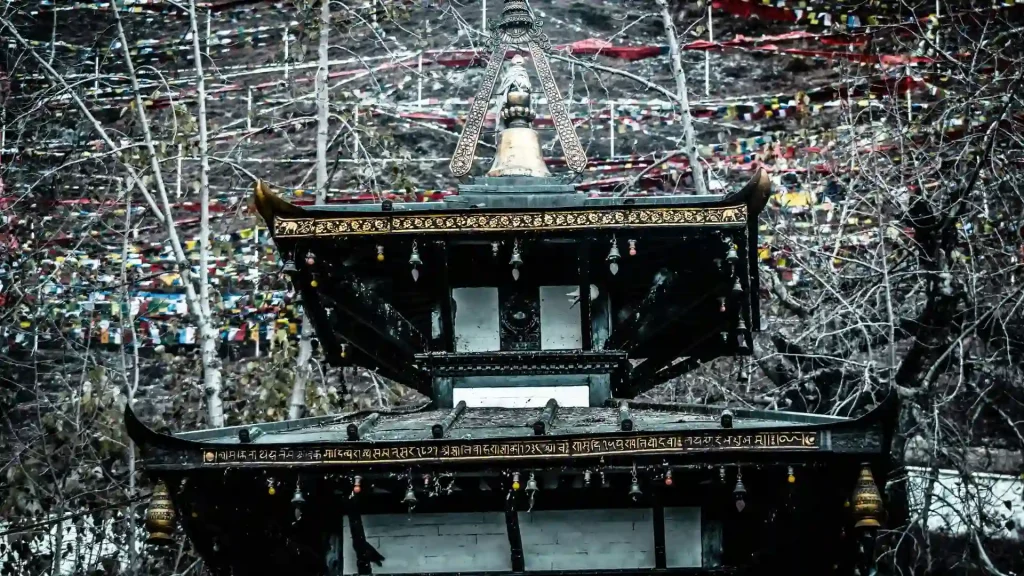
Muktinath is one of the holiest pilgrimage sites in South Asia for both Hindus and Buddhists, sitting at around 3,800 meters. Its temple complex features 108 water spouts that pilgrims traditionally bathe under, along with an eternal natural gas flame said to burn alongside a water spring. It’s accessible by road from Jomsom without any restricted-area permit.
4. Marpha
Marpha, in Lower Mustang, is known across Nepal for its apple orchards, apple brandy, and traditional Thakali stone-and-timber architecture. It’s an easy half-day stop from Jomsom and one of the most photogenic villages in the entire region.
5. Chhoser Caves (Sky Caves)
The Chhoser sky caves are a multi-story network of hand-carved chambers cut into cliff faces near Lo Manthang, believed to be around 2,000-3,000 years old. Archaeologists have found human remains, manuscripts, and artifacts inside, and some chambers are open for visitors to climb into with a local guide.
6. Jomsom
Jomsom is Mustang’s administrative center and transport hub. It is the district headquarters, airport, and jumping-off point for both Lower and Upper Mustang. Most travelers pass through here rather than staying long, but it has a small museum and is the last reliable place to stock up on supplies before heading north.
| Photography Tip: The clearest mountain visibility in the Kali Gandaki valley is almost always in the first two to three hours after sunrise, before the afternoon wind picks up haze and cloud along the gorge. Plan your best photo stops, especially of Nilgiri and Dhaulagiri from Kagbeni or Jomsom, for early morning. |
Want to explore beyond Mustang? Discover different Destinations and a guide to find more places to visit across Nepal, from mountain regions and historic cities to cultural and natural attractions.
Things to Do in Mustang
Beyond the region’s main towns, Mustang offers a specific set of experiences worth building your itinerary around.
- Visit Lo Manthang’s monasteries. Jampa, Thubchen, and Chöde hold some of the best-preserved Tibetan Buddhist murals in the Himalaya.
- Explore the Chhoser sky caves. Climb into centuries-old cliffside chambers near Lo Manthang.
- Attend the Tiji Festival (if timed right). This is a three-day masked-dance ceremony depicting the mythical hero Dorje Jono driving out a demon.
- Walk the walled city of Lo Manthang. It is one of the few intact medieval walled towns in the Himalayan region.
- Bathe at Muktinath’s 108 water spouts. This is a major pilgrimage ritual open to travelers of any faith.
- Sample Marpha’s apple products, including dried apples, apple brandy (locally called “apple raksi”), and cider.
- Ride or drive the Kali Gandaki gorge road, passing between two 8,000-meter peaks in a single valley.
- Explore Kagbeni’s mud-brick lanes. This is one of the best-preserved traditional villages in the region.
Culture and People of Mustang
Mustang’s culture reflects its history as a crossroads between Tibet and the Nepali mid-hills. In Upper Mustang, the population is ethnically and culturally Tibetan, speaking a dialect close to Tibetan and practicing Tibetan Buddhism under the guidance of monasteries that have operated continuously for centuries. Lower Mustang is home primarily to the Thakali people, historically salt and grain traders along the Kali Gandaki route, who developed a distinct cuisine and architectural style now found in Thakali kitchens across Nepal.
Religious life in both halves of Mustang centers on Tibetan Buddhist monasteries (gompas), prayer wheels, chortens, and mani walls lining the trails. Travelers are expected to pass these on the left, in keeping with local custom.
Food in Mustang
Thakali cuisine, centered on the dal bhat set including lentil soup, rice, vegetable curry, and pickle, often with meat or potato dishes, is Mustang’s most influential culinary export and is considered by many Nepali travelers to be the best version of the dish in the country. In Upper Mustang, expect simpler, more Tibetan-style meals: thukpa (noodle soup), tsampa (roasted barley flour), butter tea, and dried yak meat, reflecting the region’s higher altitude and shorter growing season. Marpha’s apples show up throughout Lower Mustang in dried snacks, juice, pie, and the locally distilled apple brandy.
Accommodation in Mustang
Lower Mustang towns like Jomsom, Marpha, and Kagbeni have a wide range of teahouses and a handful of boutique properties, with reliable electricity and hot showers in most guesthouses. Upper Mustang accommodation is more basic, with simple teahouses in villages like Chele, Syangboche, and Ghami, and a growing number of comfortable options in Lo Manthang itself. Rooms are simple almost everywhere. The appeal is location and hospitality rather than amenities.
| Budget Tip: Teahouse rooms in Mustang are typically cheap or free, with the expectation you will eat dinner and breakfast at the same lodge, but food prices climb the further north and higher you go, since everything is transported by mule or jeep. Budget more for meals in Upper Mustang than you would on more heavily trafficked routes like Everest Base Camp. |
Packing List for Mustang
Mustang’s high-desert climate and strong winds call for a slightly different packing list than Nepal’s forested trekking routes. Here’s what to bring.
- Insulated jacket and warm layers (temperatures drop sharply after sunset, even in the desert climate)
- Windproof outer shell (afternoon winds are constant and strong)
- Sun protection: hat, sunglasses, high-SPF sunscreen, lip balm
- Sturdy trekking boots, broken in before the trip
- Dust mask or buff (the jeep road and trails are notably dusty)
- Water purification tablets or a filter
- Basic first-aid kit, including diarrhea and altitude-sickness medication
- Cash in Nepali rupees (ATMs are unreliable or absent north of Jomsom)
| Safety Advice: Jomsom sits at roughly 2,700 meters and Lo Manthang at around 3,840 meters, both high enough that mild altitude symptoms, including headache, fatigue, and mild nausea, are possible even though the trek itself does not involve extreme elevation gain. Ascend gradually, stay hydrated, and treat any worsening headache or breathlessness as a signal to stop and reassess rather than push on. |
Common Mistakes to Avoid in Mustang
A few planning mistakes come up again and again with first-time Mustang travelers, and most are easy to avoid once you know about them.
- Assuming “Mustang” means only the restricted area. Many travelers plan around the $50/day Upper Mustang permit without realizing Lower Mustang requires no special permit at all.
- Booking a Jomsom flight with no buffer day. Wind-related cancellations are routine, and travelers with tight onward flights or visa timelines are the ones most affected.
- Underestimating the road to Jomsom. The overland route from Beni is rough and slow; treat it as a full-day journey, not a quick hop.
- Skipping travel insurance. Trekking insurance covering high-altitude evacuation is standard practice for anyone heading north of Kagbeni.
- Forgetting that ATMs disappear north of Jomsom. Carry enough Nepali rupee cash for the entire Upper Mustang portion of your trip.
Final Thoughts
Mustang Nepal rewards travelers willing to plan around its permits and remoteness with something increasingly rare in the Himalaya: a living Tibetan Buddhist culture, centuries-old monastery art, and landscapes that feel closer to the Tibetan plateau than to the rest of Nepal.
Whether you stick to Lower Mustang’s orchards and pilgrimage sites around Jomsom and Muktinath or commit to the full restricted-area trek to Lo Manthang, the region’s 2026 permit reforms, including the $50-per-day Upper Mustang fee and the removal of the solo-trekker restriction, have made it more accessible than at any point since it opened to foreigners in 1992.
Start by deciding how far north you want to go, then work backward from there to your permits, guide, and transport.
Permit fees and rules referenced in this guide reflect Nepal’s 2026 regulations as reported at the time of writing. Trekking regulations in Nepal change periodically, so confirm current permit costs and requirements with a registered trekking agency or the Department of Immigration before booking.
Frequently Asked Questions
What is Mustang Nepal known for?
Mustang Nepal is known for being a former Tibetan Buddhist kingdom hidden behind the Annapurna and Dhaulagiri ranges, home to the walled city of Lo Manthang, centuries-old monastery murals, and a stark high-desert landscape unlike anywhere else in Nepal.
How do you get to Mustang, Nepal?
You get to Mustang by first reaching Jomsom, either on a 20-minute flight from Pokhara or a full-day jeep or bus ride via Beni, and then continuing north by jeep or on foot toward Kagbeni and, with a restricted-area permit, Lo Manthang.
How many days do you need in Mustang?
You need at least 3-5 days for Lower Mustang and Muktinath alone, while a full Upper Mustang trip to Lo Manthang typically requires 8-12 days on foot or 4-6 days by jeep, including acclimatization stops.
How much does the Upper Mustang permit cost?
The Upper Mustang permit costs $50 per person, per day, as of late 2025, replacing the previous flat $500 fee for 10 days; you now pay only for the number of days you spend inside the restricted zone.
Can you visit Mustang without a guide?
You cannot visit Upper Mustang without a guide, since a licensed guide is mandatory for the restricted-area permit even for solo trekkers, though Lower Mustang destinations like Jomsom, Marpha, and Kagbeni can be visited independently.
What is the best time to visit Mustang, Nepal?
The best time to visit Mustang is March-June and September-November, when skies are clearest, though Mustang’s position in the Annapurna-Dhaulagiri rain shadow also makes it one of the few Nepali trekking regions still viable during the June-August monsoon.
What is the difference between Upper Mustang and Lower Mustang?
The difference between Upper Mustang and Lower Mustang is access and culture: Lower Mustang (Jomsom, Kagbeni, and Marpha) is open to all visitors with a standard conservation permit, while Upper Mustang (Lo Manthang and beyond) is a restricted area requiring a special permit and a mandatory guide, with a landscape and culture closer to the Tibetan plateau.
Do you need a permit for Lower Mustang?
You need only the standard Annapurna Conservation Area Permit (ACAP) for Lower Mustang, not the Restricted Area Permit that applies specifically to Upper Mustang beyond Kagbeni.
Can solo travelers trek to Upper Mustang?
Solo travelers can trek to Upper Mustang as of March 2026, when Nepal’s Department of Immigration removed the previous two-person minimum for restricted-area permits, though a licensed guide arranged through a registered agency remains mandatory.
What is the Tiji Festival in Mustang?
The Tiji Festival is a three-day masked-dance ceremony held in Lo Manthang depicting the mythical figure Dorje Jono defeating a demon threatening the kingdom, typically held in May according to the Tibetan lunar calendar, with exact dates shifting each year.
Is Mustang worth visiting?
Mustang is worth visiting for travelers interested in Tibetan Buddhist culture, dramatic desert landscapes, and destinations that remain far less crowded than Nepal’s more famous trekking routes, though the restricted-area permit fees and guide requirement make it a pricier trip than most.
How difficult is trekking in Mustang?
Trekking in Mustang is considered moderate rather than extreme. The terrain involves long daily walking distances and a few passes over 3,500 meters, but without the sustained high-altitude exposure of routes like Everest Base Camp or Annapurna Circuit’s Thorong La.
Sources
Nepal Tourism Board: https://ntb.gov.np/
Department of Immigration, Government of Nepal: https://immigration.gov.np/
National Trust for Nature Conservation (NTNC): Annapurna Conservation Area Project: https://ntnc.org.np/
UNESCO World Heritage Centre (regional Himalayan cultural heritage context): https://whc.unesco.org/